T
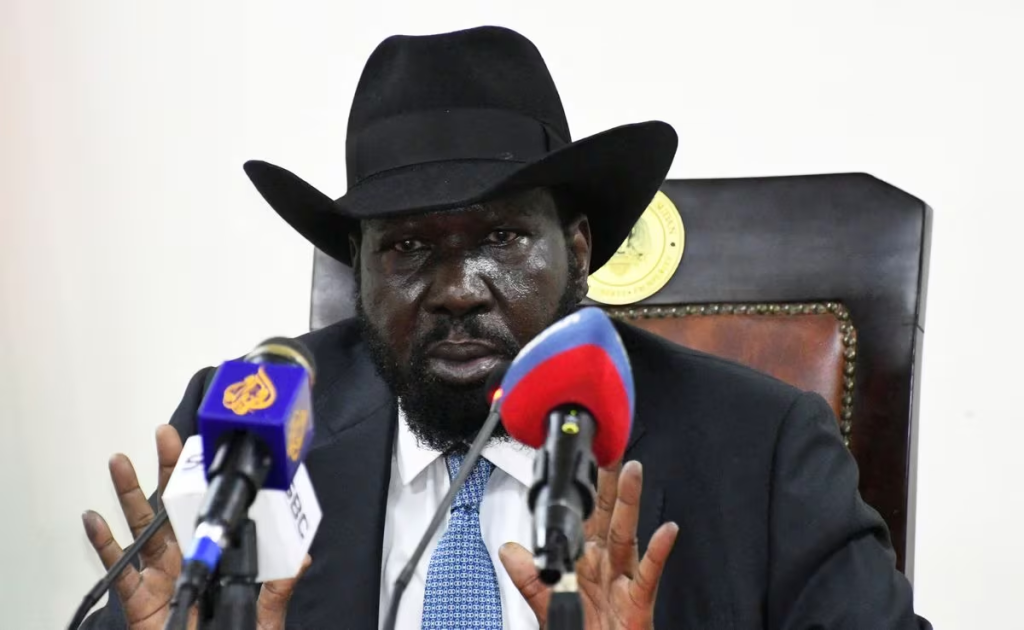
he South Sudanese leader, Salva Kiir Mayadit assumed leadership of the East African community in November 2003 at a very crucial time
He took the East African Community Regional Force (EACRF) and was leaving DRC after protests by President Felix Tshisekedi that the force had come to promote the looting of Congo minerals instead of fighting M-23. The Congo leadership saw EACRF as serving the interests of Rwanda, Uganda, and Kenya. President Kiir also took leadership at an intriguing moment when he welcomed Somalia the bloc’s eighth member, a move that caused rifts in opinion throughout the region.
Observers of the EAC are worried about the community’s future in light of the recent heated exchange between the presidents of Burundi, Rwanda, and the DRC. Because Kigali is purportedly supporting the Red Tabara rebels. Burundi severed diplomatic ties and closed its border with Rwanda.
Yet, President Kiir—despite his perceived weakness for not pacifying South Sudan since civil war broke out in 2013—managed to go to Rwanda and set up a bilateral committee to deal with the DRC issue. He also toured DRC and Burundi. Despite his tours to de-escalate the conflict in the Eastern DRC, the conflict has intensified since the withdrawal of EACRF, whose mandate expired late last year.
The visit was the first test of President Kiir’s EAC leadership. The EACRF mission has been taken over by the Southern African Development Community (SADC) forces, with strong opposition from Rwanda.
President Kiir also met with President Tshisekedi and Evariste Ndayishimiye, the president of Burundi, who has accused Rwanda of arming rebels against his government. Kiiri is trying to find a way to bring the three EAC members closer together.
Nonetheless, Kigali refutes the DRC’s and Burundi’s assertions. President Kiirr is supposed to bridge the gap between the Nairobi Process a dialogue push led by Kenya’s former president Uhuru Kenyatta, and the Luanda Process, led by Angola’s President Joan Lorenco.
Such is a huge task at a time when President Tshisekedi and President Evariste Ndayishimiye on the other hand have accused Rwandan President Paul Kagame of sponsoring M23, also alleged by the UN and the US.
President Kiir is leading EAC at a time when five members of EAC—DRC, Rwanda, Burundi, Uganda, and Tanzania—are on the verge of confronting each other thus posing an existential threat to the survival of the regional bloc. Burundi has severed relations and closed its border with Rwanda Burundi because Kigali is allegedly supporting the Red Tabara rebels. Burundi’s Interior Minister, Martin Niteretse described President Kagame as a “bad neighbor harboring criminals who are destabilizing Burundi.”
President Kiir—as EAC chair—is facing the daunting task of convincing the leaders to talk to each other to not only enable the EAC citizens to benefit from cross-border trade and the integration process but also to avoid a repeat of the 1977-type collapse.
In 1977, the EAC which included Kenya, Uganda, and Tanzania collapsed after being founded in 1967 mainly due to personality and ideological differences. On the one hand, Kenya under Jomo Kenyatta had embraced capitalism, while Tanzania under Julius Nyerere was rooting for Ujamaa, a major African socialist policy at the height Cold War.
Nyerere and Uganda’s Idi Amin also have irreconcilable personal differences due to the belligerence of the latter. On revival in 1999 and starting operations in 2000, those in power then—Daniel arap Moi Kenya), Benjamin Mkapa (Tanzania), and Yoweri Museveni of Uganda—pledged to manage the personality and ideological clashes to prevent another breakup.
However, EAC has been grappling with many challenges since its inception in 1967 and revival in 1999—some of which exist today. These include perpetual political differences that have increased as more members join the community.
The political systems, histories, and priorities of the EAC’s member states—Uganda, Burundi, Kenya, Rwanda, South Sudan, Tanzania, the DRC, Somalia, and Kenya—are diverse and are yet to be streamlined.
It can be difficult to manage these disagreements and promote agreement on regional issues, especially when it comes to governance, human rights, and political reforms. This ties closely with the fear among leaders of losing their national identities and sovereignty to the process of integration.
Most member states prioritize national sovereignty and independence over regional integration efforts, or being overshadowed by more powerful neighbors has led to resistance to deeper integration and cooperation within the EAC
Due to nationalism and sovereignty concerns, non-tariff trade barriers and trade disputes continue to exist within the EAC, despite efforts to promote regional trade integration. Problems like tariff disputes, lengthy customs procedures, and restrictive regulations impede the free flow of goods and services, which impedes efforts at regional integration and economic growth.
There are several security issues that the East African region must deal with, such as terrorism, ethnic conflicts, and cross-border criminality. The instability prevailing in nations such as South Sudan, DRC, and Somalia has a knock-on effect neighbouring states, endangering regional stability and impeding attempts at economic development.
Then there is the weak institutional governance. The EAC faces issues with governance, corruption, and weak institutions, just like many other African regions. This comes into question as President Kiir will be facing the first elections in December 2024 since independence in 2011.
While President Kiir lacks the diplomatic power to preach peace to other EAC states about peace, he has the advantage of telling them what was can do to a country, like it has done to South Sudan. Can President Kiir where the whole world has failed? That remains the question and the test of his EAC leadership in the remaining nine months .