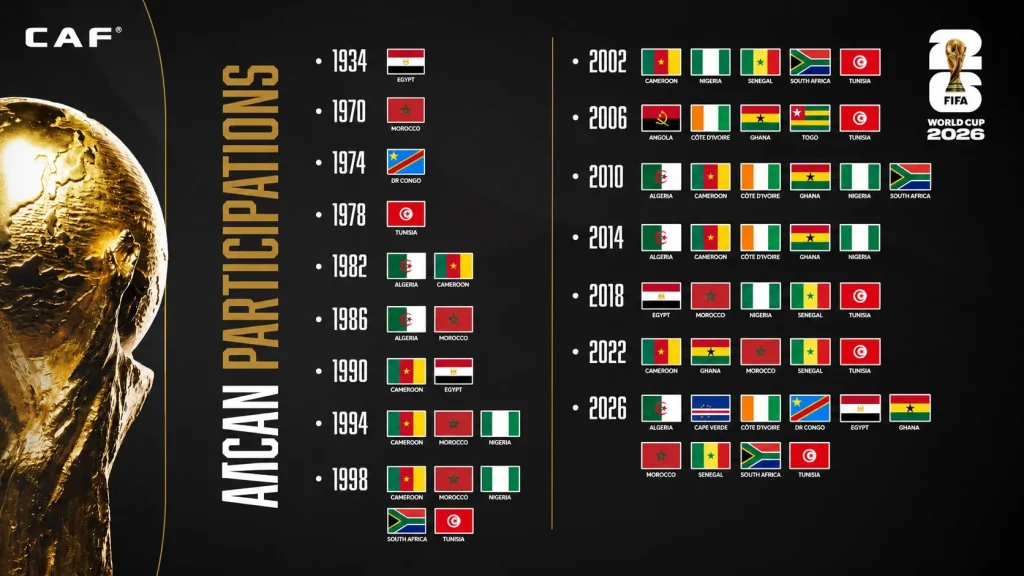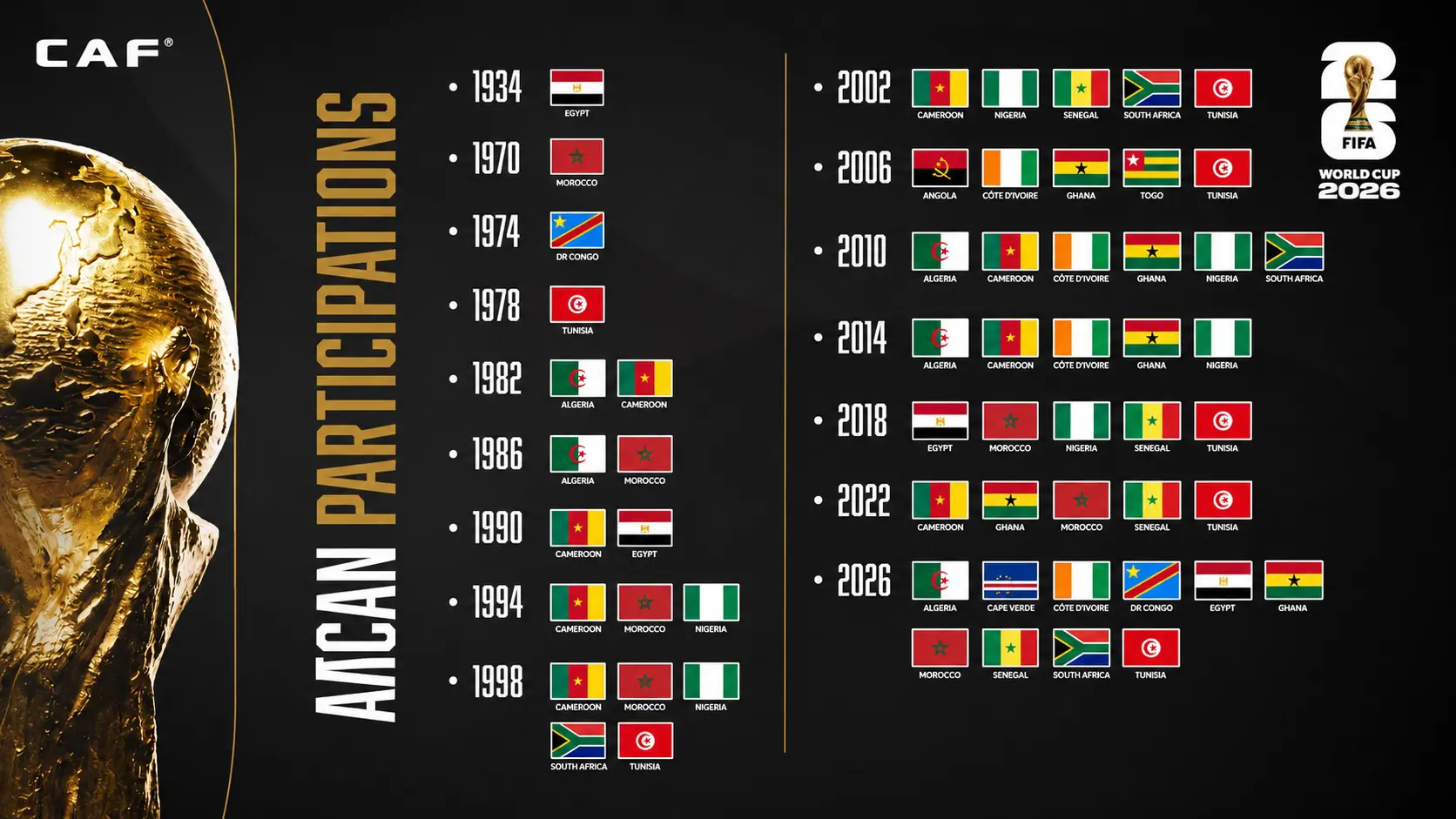
With the group stage of the historic 48-team World Cup completed, Africa’s representatives have left no doubt that the continent has come of age. The increased representation was deserved and not a mere favour.
Of the continent’s 10 representatives- South Africa, the Democratic Republic of Congo (DRC), Cape Verde, Ghana, Côte d’Ivoire, Senegal, Morocco, Algeria, Tunisia and Egypt- only Tunisia failed to make it to the knockout stage.
The Eagles of Carthage, as the Tunisians are colloquially known, once again failed to break the jinx that has haunted them since they made their tournament debut in 1978 in Argentina. Despite being the first African team to win a World Cup match when they beat Mexico in 1978, the Tunisians have never progressed beyond the group stages.
Tunisia, who were in Group F, lost all their round-robin matches. They suffered 3-1 loss to the Netherlands and 4-0 defeat to Japan on June 20. The consecutive defeats came shortly after the Eagles of Carthage suffered a 5-1 hammering by Sweden in the opener.
The round of 32 runs from June 28 to July 3, and hopes are high that a good number of Africa’s representatives will advance, and perhaps match or better the semi-final record set by Morocco in the 2022 contest in Qatar. A number of the African teams were pitted against the global soccer giants in the preliminary rounds.
Of the qualifiers, Cape Verde (officially Cabo Verde) deserves a special mention. The nation of 10 volcanic islands in the central Atlantic Ocean, situated about 500km off the coast of West Africa (near Senegal), has only a population of approximately 550,000 people.
They completed a historic undefeated run in Group H, drawing all three matches to finish as runners-up behind Spain to advance. Having held the European champions to a goalless draw, Cape Verde held South American Uruguay 2-2 draw and crowned it with a 0-0 draw with the oil-rich Saudi Arabia.
In Group A, South Africa’s Bafana Bafana unexpectedly hit South Korea 1-0 on June 24, having started badly with a 2-0 defeat by the co-hosts Mexico. With a 1-1 draw against Czechia, they officially advanced to the Round of 32, marking their first time taking part in the knockout rounds.
Morocco was not a disappointment in Group C. They finished on seven points, after one draw and two wins. The Atlas Lions held Brazil to a 1-1 draw, beat Scotland 1-0, and beat Haiti 4-2.
With an admirable World Cup legacy, Egypt finished second in Group G, below Belgium on goal difference. They amassed five points, sealing a knockout qualification for the first time. Egypt were the first African and Arab team to ever participate in the tournament in 1934. Their four historic appearances include the 1934, 1990, and 2018 tournaments.
A double by Europe-based Nicolas Pepe sealed Cote d’Ivoire’s first trip to the knockouts with a 2-0 victory over Curacao, as the African team finished second in Group E. In previous group games, they lost 2-1 to Germany and won 1-0 against Ecuador. Côte d’Ivoire are in the global soccer fest for the fourth time, having debuted in 2006. They also featured in the 2010 and 2014 contests.
With a disastrous 3-0 opener defeat against tournament favourites France, and a narrow 3-2 loss to Norway, in Group I, Senegal smashed Iraq 5-0 in the final group fixture, which proved enough to send them to the next round as one of the eight best third-placed sides.
Algeria, from Group J too did enough to qualify as one of the eight best third-placed teams. Better known as the Les Fennecs (The Fennec Foxes) or simply The Desert Foxes, they overcame a 3-1 defeat by Argentina to amass four points, thanks to a 2- 1 win against Jordan, and a 3-3 draw against Austria.
With a 3-1 win over Uzbekistan in their final group game, DR Congo reached the knockouts for the first time, advancing as the third-placed team from Group K. The Congolese, who had a longer journey to the 2026 tourney, were making a return, having first appeared in the 1974 event when they were then known as Zaire. The Congolese drew 1-1 with group favourites Portugal and secured 1-0 and 3-1 wins against Colombia and Uzbekistan, respectively. Ghana made it to the round of 32 in Group L after collecting four points from their first two games. Ghana beat Panama 1-0, held England 0-0, but lost 2-1 to Croatia.
Africa’s World Cup journey has been nothing short of an odyssey. It will be recalled that in the earlier years, Fifa did not guarantee the continent any qualification spots. Fifa instead grouped African nations with teams from Asia and Oceania, forcing them to compete in a playoff for a single shared spot. With the majority of the countries shaking off the yoke of colonialism, African nations collectively boycotted the 1966 World Cup to protest Fifa’s decision.
With the apparent good progress, pressure is building on the Confederation of African Football (CAF) to lobby Fifa for more slots for Africa in the next tournament, which could boost Africa’s chances of winning the World Cup.
Still, CAF would be well advised to address the unequal regional soccer development. The domination of the continent’s football, at both club and national levels, by Western and Northern African teams leaves a lot to be desired.