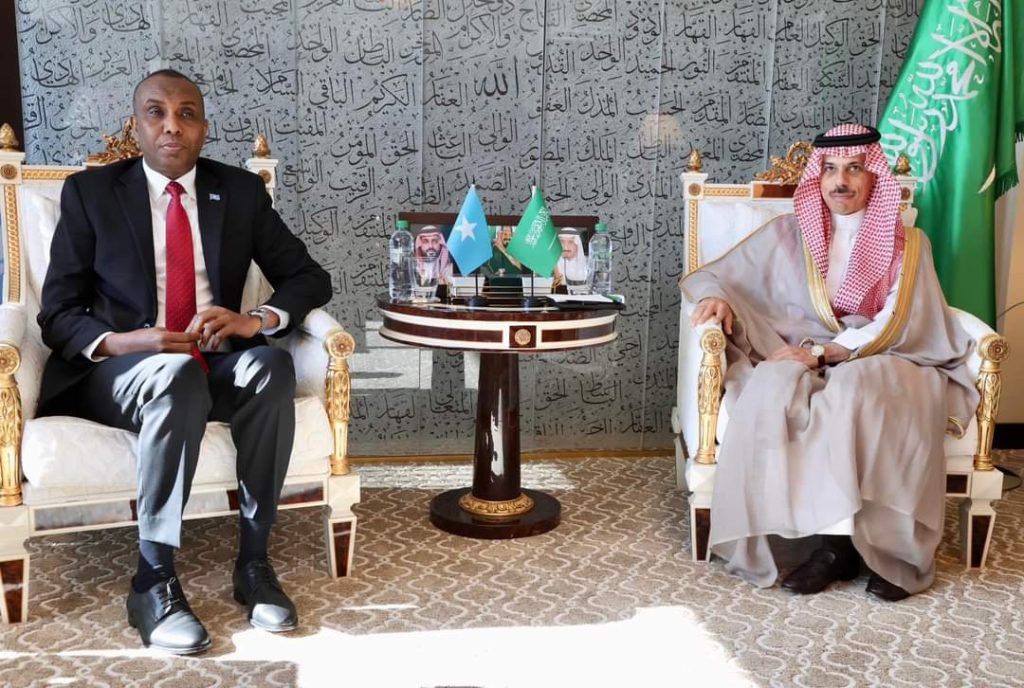

Following a series of actions by both parties in recent months, the relationship between the Federal Republic of Somalia and the Kingdom of Saudi Arabia has reached a new phase that reflects diplomatic, security, and economic rapprochement.
Riyadh’s unambiguous stances on Somalia’s unification, the signing of new defence and maritime transportation deals, and the recognition of the recently appointed Somali ambassador to the nation are all examples of this recent progress.
Without taking into account the significant changes occurring in the Horn of Africa and the Red Sea region, where they are increasingly contending with Gulf countries, particularly Saudi Arabia and the United Arab Emirates, it is impossible to comprehend the improvement in Somalia-Saudi ties.
This changing regional climate has compelled Somalia to reconsider its alliances and relations with key countries.
Saudi Arabia’s position on Somalia’s unity was made plain earlier this year, when senior Saudi officials reaffirmed Riyadh’s unequivocal support for Somalia’s independence, unity, and territorial integrity. This assistance came at a time when Mogadishu was anxious for Arab and Islamic backing against any action that threatened the country’s survival.
Egypt’s Role:
Egypt’s role is The warming connection was further enhanced by Somali President Hassan Sheikh Mohamud’s visit to Cairo in February, during which he met with Egyptian President Abdel Fattah al-Sisi. The conference occurred at a time when Egypt and Saudi Arabia were strongly aligned on the Somalia issue, particularly in terms of regional security, unity, and stability.
The most apparent indication that Somali-Saudi relations had progressed beyond conversation and rapprochement occurred on February 9, when Somali Defence Minister Ahmed Moalim Fiqi and his Saudi counterpart, Prince Khalid bin Salman, signed a military accord in Riyadh.
The agreement paved the way for further defence collaboration, training, technical support, and security cooperation between the two countries.
The deal sent a clear statement that the two governments intended to move their relationship beyond traditional diplomacy and toward a more comprehensive security alliance. Somalia, which still confronts significant security difficulties, sees this alliance as critical to improving its military capabilities and establishing a regional footprint.
Following that, the two sides focused on the economic and maritime sectors, signing a cooperation agreement on maritime transport and port development. The pact aims to improve marine connectivity, increase passenger and cargo transportation, and promote the role of ports in regional trade.
This demonstrates that the new partnership is more than just about politics and security; it also has a direct impact on both countries’ economic and strategic interests. Somalia, which has Africa’s longest coastline, prioritises any collaboration that improves port utilisation and its involvement in regional waterways.
New ambassador:
On the diplomatic front, another unambiguous signal came when the Saudi Ministry of Foreign Affairs officially received the credentials of Mohamed Amin Sheikh Osman, the kingdom’s new Somali ambassador. The move is viewed as the end of a period of slowness and uncertainty about the state of bilateral relations.
The admission of the new ambassador also signals that Riyadh has fully reopened direct communication channels with Villa Somalia, allowing the two administrations to maintain regular, transparent, and high-level relations.
The significance of this adjustment is heightened by the security situation in Somalia and the federal government’s need for further external assistance. The new African Union Mission in Somalia, AUSSOM, is facing budgetary and operational constraints that outweigh any regional contingents.
If Saudi Arabia takes a more prominent role in assisting AUSSOM or bolstering the Somali Armed Forces, it might have a significant impact on domestic stability and the government’s ability to battle armed groups. As a result, improving relations between Riyadh and Mogadishu are more than just a diplomatic problem; they may also have an impact on Somalia’s national security.
President Hassan Sheikh recently emphasised Villa Somalia’s vision for Saudi Arabia, emphasising that Somalia is collaborating with a Saudi-led coalition to defend regional security and prevent activities that harm Somalia’s unity.
When combined with recent political positions, security and maritime agreements, the acceptance of a new ambassador, and the possibility of a high-level state visit, the emerging picture shows that the Somali-Saudi relationship has entered a new phase that goes beyond diplomatic rapprochement and toward a strategic partnership that considers security, economy, and regional challenges.