

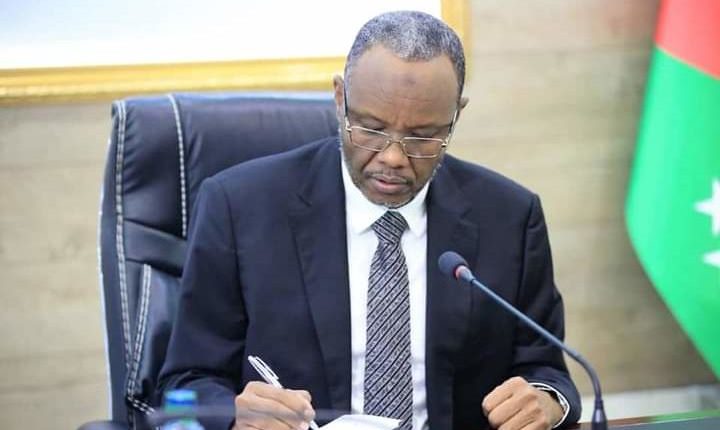
Abdulaziz Hassan Muhammed, South-West State president in Somalia, commonly known asLaftagareen, left to Kenya after he was ousted in early April by the central government from a seat he had occupied since December 2018.
He insists in an interview withAfroEconomist that he is still the legitimate president of South-West State. He was replaced by former Deputy Prime Minister Abdirashid Haji.
Excerpts
Can you give the circumstances under which you were ousted and by whom?
The federal army took control of Baidoa, the region’s main city, with the central government accusing me of extending my mandate past its scheduled expiry in 2022.
According to the federal constitution and the state constitution, the election of the state is independent. It concerns the local people and the local parliament, following the local constitutions at the state level. Five federal member states in Somalia are supposed to be independent and hold their elections in their own time.
I was elected in December 2018 and the term is five years. After the term ended, I proposed holding elections again for a second term. However, there was a political agreement between the federal government and the state members to unify elections for all state members at once.
Do you think, after you were ousted, the Somali constitutional order has collapsed?
Before I was ousted, the Somali constitution had already been undermined because the president made decisions to change the constitution for his own interests. After that, he was also removed. The isse of holding elections at the same time has not yet been settled since all five states—Puntland, Jubbaland, Galmudug, South West, and Hirshabelle—have their different election timetables.
During your presidency, how were you relating to the central government?
The relationship was not good; it was strained. Although I tried to compromise and work for the benefit of the Somali people, the federal government was not satisfied. Relations between federal member states and the central government worsened, and Puntland and Jubbaland had already distanced themselves. I tried my best, but the situation remained difficult.
What about the rumours that you were given money to step down?
That is just a rumour. No money was paid. I could not support such claims while in office, and there is no basis for them. I was elected with legitimacy from the parliament and traditional leaders in the state, but I was unfortunately ousted. There is no valid agreement supporting such claims.
Can you give the unique situation in the South West regarding resources and security?
South-West is the breadbasket of Somalia. It has a lot of natural resources like oil and gas, plus minerals and livestock. The fellow governors had agreed to explore oil and gas in Lower Shabele and riparian areas. There is also the challenge of land grabbing and displacements. That is why the government is trying to use some people to exploit the resources. This is about a conflict of interest.
However, South-West has been affected by climate change and conflicts. But it is the first time the people have experienced peace for the last 12 years since the state was established in 2014.
What is the security situation in the South West, and how did SNA reach Baidoa? Were they working with Al-Shabaab?
The main supply route has been controlled by Al-Shabaab for the last 14 years. It is approximately 245 km from Mogadishu to Baidoa. They SNA used the same route by bribing Al-Shabaab. There is some agreement between the central government and Al-Shabaab, and that is why the militants have been able to control this route for all those years
Do you think the country will achieve a national constitution?
The constitution needs wide consultations with all stakeholders, the people, and the five federal states. The current constitution is a transitional one that was agreed in Kenya in 2004. That was officially known as the Charter, but in 2012, the people agreed on a transitional constitution.
The only challenge is that President Hassam Sheikh Mahmoud and his clique are trying to make amendments to favour their interests without involving the wider public
The stand-off is part of a wider row over constitutional reform adopted in early March. The reform notably extends the presidential term to five years and introduces universal suffrage for the election of members of parliament, replacing the indirect clan-based system.
Do you think Somalia is ready for universal suffrage, one person, one vote, which was last done in 1969?
It would be good for Somalia to have one-person, one-vote elections as part of the constitutional order. But for various reasons, it could not happen. There was manipulation, with the president trying to impose his own election system and party, influencing the national election process. Many states had concerns, and it was not a commonly agreed-upon election.
Are you planning to run for the national president of Somalia?
I am still the legitimate president of South-West, and the issue of contesting for the national presidency does not arise at the moment. But when we reach the time for contesting the national presidency, we will decide at that time.
