

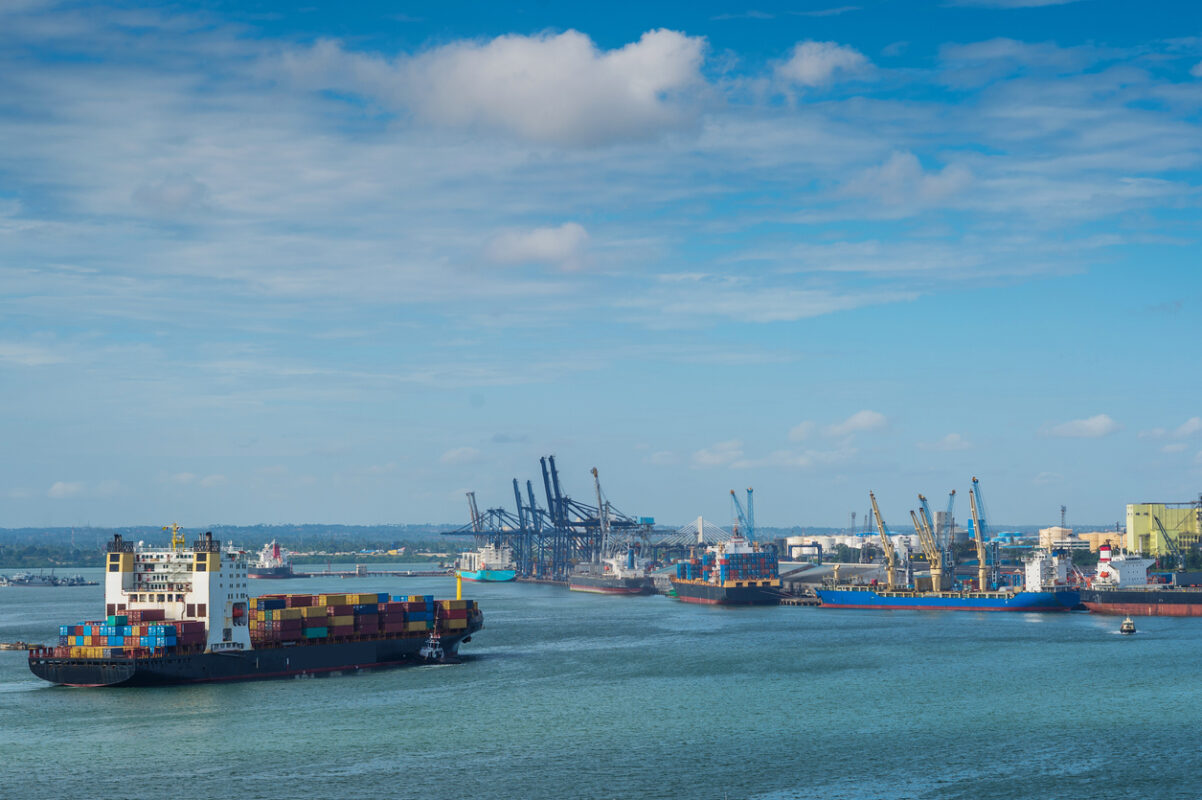
The Dar-Salaam port has attracted foreign investors who want to make it competitive given the stiff competition it faces from neighbouring countries, especially the port of Mombasa.
Having seen its performance fall way behind, the Tanzania government has granted another contract lease of a 30-year concession agreement to Adani International Ports Holdings Ltd (AIPH) to operate and manage container terminal 2 at the port to achieve high capacity to enable higher volume handling.
The recent signing of the concession with the Tanzania Ports Authority (TPA) will see AIPH take over the running of berths from 8 to 11 which have an annual cargo handling capacity of one million Twenty-foot Equivalent Unit (TEU).
TEU is an exact unit of measurement used to determine cargo capacity for container ships and terminals. The four berths handled an estimated 83 percent of Tanzania’s total container volumes during the 2022/23 trading period.
According to economic experts, the move is likely to ignite fierce competition in future with DP World which already operates part of the port potentially revamping business, improving infrastructure and boosting the port’s general efficiency. DP World currently operates six ports in Africa and more than 30 ports worldwide.
Adani, India’s multinational port operator, is expected to compete for business with Dubai state-owned DP World, which in October 2023 was also granted three contracts for a 30-year concession period by the Tanzania government to run berths four to seven at the port.
Under the contract, DP World committed to invest $250 million over the next five years to upgrade facilities to improve cargo clearing systems and eliminate the existing delays. The company has been expanding its African port portfolio with an investment of $ 10 billion mainly in African ports in countries such as Angola, Djibouti and Egypt.
This has generated debate among Tanzanians immediately after parts of the Inter-governmental agreement between Tanzania and Dubai leaked with some Tanzanians saying there was no need for the government to leave the running of a sensitive infrastructure such as a port to a foreigner.
After the government explained that it had assigned the company to run the operation because it has no handling facilities to run the port effectively, some agreed that giving the port’s operations to a private firm was a good idea but that it should have been a domestic operator instead of a foreign firm like DP World. The Roman Catholic Church released a statement of contradiction to oppose the move but was ignored.
While the debate lingers, it is obvious that privatisation of operations at Dar es Salaam port is unavoidable given its current circumstances.
The two International investors will help increase work efficiency such as handling cargo to avoid high congestion bearing in mind the fact that “the port continues receiving as many cargo ships as it can for the facilitation of goods to landlocked countries located in SADC as well as in East African regions.
The new agreement with Adani grants the company rights to operate and manage container terminal two which was previously being operated by Tanzania International Container Terminal Services Limited (TICTS) that handed containers between berths 8 and 11 up to May 2022 when the lease contract expired.
For over two decades, a major part of Dar es Salaam port has been handled by TICTS until its contract expired earlier this year and the government showed no intention of extending it.
Improving Tanzania’s Dar es Salaam port is crucial for the East Africa region and the SADC countries, officials say that “the country expects more revenues through this port and without any doubts investments are a must to boost trade”.
Dar es Salaam port is currently known for slow operations. This means connecting transportation between the Atlantic Ocean and the Indian Ocean. The improvement of Dar es Salaam port is crucial for the onward transportation of cargo.
It is for these reasons that Tanzania’s President Dr Samia Suluhu defended her government’s decision to privatising the port to these two companies at a meeting held last week in Seoul South Korea that aimed to overlook Africa’s main infrastructural capabilities.
In her speeches, the Head of State noted that the current investment at Dar Port is aimed at helping exchange expertise and long-term technology to bring efficiency and such an investment is a blueprint for the infrastructure projects for the national development investments.
With these two investors assigned at the port, the government is optimistic that its customs revenues through Dar es Salaam port are set to increase from the current level of $3.25 billion to $11.13 billion between 2025 and 2030. The amount is equivalent to more than half of Tanzania’s annual budget.
General operations are also expected to be faster, the cost of transport cheaper for neighbouring countries and transportation of goods between African countries, and other parts of the world including Europe and Asia will be facilitated.
A report published by the World Bank in 2013 showed that in 2012, loss resulting from inefficiencies at the Dar es Salaam port was estimated to be $ 1.8 billion for the Tanzanian economy and $ 830 million for the neighbouring countries which depended on poor handling facilities.
Two years ago, the port was unable to handle large ships, considering that it had shallow berths that could only handle ships with a maximum capacity of 8,000 containers.
Given this, the Tanzania Ports Authority (TPA) resolved to invest a total of $ 420 million in deepening and widening the gateway to berths one to seven under the program known as the Dar es Salaam Maritime Gateway Project (DMGP).
In December last year 2023, TPA completed the dredging of the entrance channel and turning basin to the berths, meaning the port can now handle vessels with a beam of 32 meters and a draft of 13.5 meters respectively.
Currently, the port’s operations are not running as smoothly as required because is facing stiff competition from neighbouring ports and has been troubled by a limited capacity to handle higher volumes and bigger ships despite the dredging exercises that involved seven berths being completed.
This is mainly due to crude technology being applied while handling cargo that does not meet international standards. Economic experts have noted that the ineffective state of operations at the port is mainly caused by a lack of modern technology and State-of-the-art operational facilities such as handling equipment have slowed down its performance at a low level of expectations.
The Dar es Salaam port provides a gateway for 90 percent of Tanzanian trade and is also the access route to six landlocked countries including Malawi, Zimbabwe, Zambia, Burundi, Rwanda, and Uganda, as well as DR Congo. Long delays in cargo handling have become a phenomenon as ships are waiting long hours just to berth and be able to unload and move their merchandise.
Statistics show that the annual handling capacity at the port is estimated at 41.1 million for dry cargo and 6 million for bulk liquid cargo. It has a limited ability to handle ships with a minimum capacity of 8,000. This is relatively low compared to neighbouring ports such as Mombasa in Kenya.

