

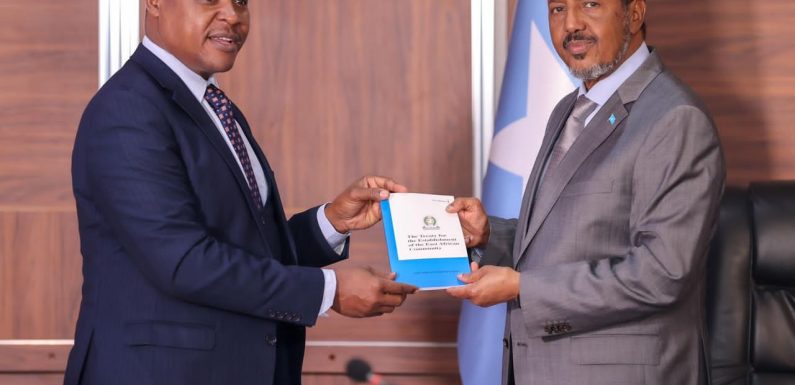
There is excitement in Mogadishu that Somalia could soon join the seven-member East African Community despite the country having not met some of the key criteria.
Just like the Democratic Republic of Congo (DRC) that was admitted to DRC, the process of admitting Somalia appears to have been fast-tracked in recent months even though Somalia first applied for membership in 2012. the EAC Heads of State signed the Verification Report on May 31, which was conducted to determine Somalia’s eligibility.
“The adoption of the verification report is a noteworthy milestone and testament that Somalia will be a great addition to the EAC sisterly countries and contribute to the integration and the prosperity of the region,” the Somalia government said in a statement released on June 2.
From January 25 to February 3, 2023, a verification team made up of experts from the EAC Partner States and headed by Mrs Tiri Marie Rose, visited Somalia to determine the country’s level of compliance with the requirements for admitting countries to the EAC. The team also reviewed the status of Somalia in international law and establish the country’s readiness to join the EAC Customs Union, Common Market Protocol, Monetary Union and ongoing political confederation Constitutional Framework.
One of the first requirements for a country to be admitted into the EAC is to share a border with at least one member state. Somalia borders Kenya to the East and should the country be admitted, it could open the way for the remaining countries that border Somalia such as Ethiopia and Djibouti to also start thinking of EAC membership.
The verification team looked at the institutional frameworks in place—the legal frameworks, the policies, strategies, projects, and programmes, as well as the areas of cooperation with other EAC Partner States and membership expectations. Other criteria include adherence to universally acceptable principles of good governance, democracy, the rule of law, observance of human rights and social justice; potential contribution to the strengthening of integration within the East African region, and; geographical proximity to and inter-dependence between it (the foreign country) and the EAC Partner States.
Somalia’s membership in the EAC could benefit the country from the free movement of people from Somalia and other countries without a visa. According to Somalia’s Minister of Foreign Affairs and International Cooperation, Abshir Omar, Somalis are already present in the East African region since they started integrating with their brothers and sisters of the region way before the request of formalising the decision of joining the EAC.
Other EAC member states such as Kenya, Uganda, Tanzania, Burundi, Rwanda, and South Sudan. Some countries like Tanzania and Burundi and DRC –are bound to benefit from Somalia’s blue economy.
With the longest national coastline of over 3,000 kms in Africa, linking Africa to the Arabian Peninsula, a vibrant economic zone. Somalia is also leading in livestock population and valuable mineral deposits such as oil and gas.
President Hassam Sheikh Mahmoud—who started the push for EAC membership in 2012 during his first term—maintains Somalia is inherently a member of the East African Community because all of the EAC Partner States have commercial ties to Somalia, and there have long been linguistic and cultural ties as well.
Kenya, which opened the border with Somalia after 12 years of closure, is likely to be the leading beneficiary in expertise labour and trade. In 2022, Kenya’s Miraa exports to Somalia hit $29 million.
Despite the potential benefits, there are concerns that fast-tracking of Somalia’s membership before it meets all the criteria could be counterproductive given the experience with Burundi, Rwanda, South Sudan, and DRC.
In 2007, Burundi and Rwanda were admitted to the EAC with the hope that they would adopt good governance practices. It didn’t happen.
In 2012, South Sudan and Somalia expressed interest in joining the bloc. South Sudan was admitted not because it met the set threshold but, just like Rwanda and Burundi, it was emerging from a history of war and EAC leaders felt it was wise to admit it so that it would be easier to influence it from within to embrace peace. Somalia’s application was then rejected because it was in political turmoil and civil war, while governance institutions are yet to be reconstructed.
Some member states are also worried that free movement of people could open the floodgates for Al Shabaab to move freely in the region and instigate insecurity. But EAC Secretary-General, Dr Peter Mathuki maintains that Somalia is important to the region despite comparisons with South Sudan, which is yet to fully integrate seven years after its admission into the regional bloc.
Dr Mathuki argues that once Somali is admitted, the EAC will address the issue of Al Shabaab within the bloc’s framework, and as he put it; “It becomes our responsibility”.
The other member that is still struggling to fit in DRC was admitted in April 2022 after the fast-tracking of their application submitted in 2019. Despite an attractive market of 86.7 million, the conflict in the east is overshadowing the benefits the EAC members can reap from DRC and vice-versa.
Mr Omar says Somalia will benefit significantly through the increased movement of goods, services, and people across the bloc in addition to expanding intra-regional trade. Further, the exploitation of Somalia’s blue economy resources such as fish will boost the regional economy.

