

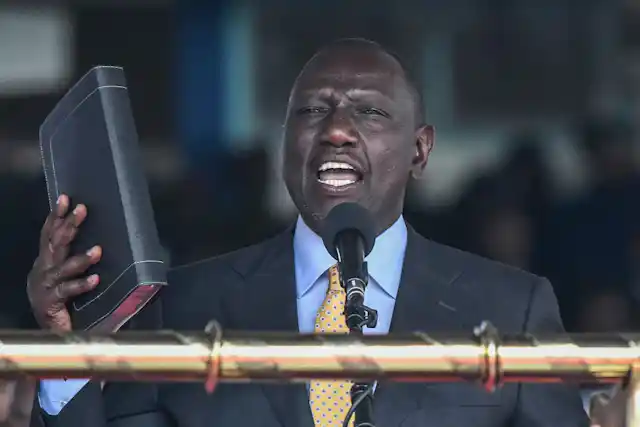
Offended by President William Ruto’s seemingly insatiable appetite for international travel, some Kenyans are considering a law to cap the chief executive’s trips to five per year.
Led by popular comedian Eric Omondi, they say—and many more Kenyans seem to agree—that the trips were a big drain on the economy with barely anything to show for them.
Of course, enacting such a law is a preserve of parliament which would be an uphill task in the House where Ruto enjoys the majority. Ruto has effectively emasculated both the National Assembly and the Senate, where nothing he does not want can pass.
According to The Africa Uncensored, immediately after Ruto took power, he and his deputy Rigathi Gachagua embarked on an extensive series of 51 trips to 34 countries, averaging about four trips per month.
The significant globetrotting occurred despite President Ruto’s earlier commitment to cut recurrent expenditures by over $ 2.3 billion. Paradoxically, his office received the highest additional funding among all cabinet members in the supplementary budgets, predominantly allocated for recurrent expenses.
In his less than 100 days in office, the Kenyan president had probably made more international trips than the more judicious former presidents of Botswana and Tanzania Ian Khama and John Magufuli respectively, made in five years.
Ruto went to the UK, the US, South Korea, Ethiopia, and the Democratic Republic of Congo, to mention but a few. Between September 2022 and November 2023, President Ruto’s most frequent destination was the US, which he visited thrice, two of which were dedicated to attending the annual United Nations General Assembly (UNGA) in New York.
Additionally, Ruto visited the UK, Tanzania, Uganda, and Ethiopia three times in the same period for regional heads of state meetings and bilateral discussions.
Meanwhile, Gachagua’s travels within the same period included visits to Italy, Rwanda, Belgium, and Colombia and a vacation trip to South Africa in December 2022. Usually, their travel arrangements involve numerous personnel, vehicles, hospitality costs, and fuel expenses.
Unsurprisingly, there has been a significant surge in Kenya’s travel expenses, coupled with a blatant disregard for the established policies, for the short period Ruto has been president.
Ministries, departments, and agencies (MDAs) collectively expended over $158 million on both foreign and domestic travel during the financial year 2022/23 alone. So far this year, Ruto has made at least 20 international trips, including the latest to Italy and Switzerland.
In Italy, Ruto attended the G7 Summit and then proceeded to Switzerland for a meeting on the Ukraine and Russia wars. It was instructive that the trips to Italy and Switzerland, which followed another to South Korea, came even before the dust had settled over the cost of his travel to the US.
The popular belief was that his private jet hired from the Middle East alone cost $1.5 million, but he insisted that he paid only $78,000 with his ‘friends’ in the Arab world settling the balance.
His entourage of more than 30 included immediate family members and Kenyan comedian and scriptwriter Eddie Butita. Indeed, the size of delegations accompanying a travelling president or cabinet secretary has been among the specific sources of discontent among citizens.
Mwangi Maina, a journalist with over seven years of experience covering foreign policy, echoed the sentiment. “Moses Kuria when he was the Trade minister, would travel with a delegation of more than 40 people.
“That’s craziness, that’s absurdity,” he asserted. However, Mwangi acknowledges the inherently costly nature of foreign policy in the same breath. But give it to Ruto; the former deputy president has stuck to his predecessor Uhuru Kenyatta’s script of not seeing any foreign trip he did not want to partake.
Uhuru, who served the maximum 10 years in office between 2013 and 2022, made 92 trips in his first five-year tenure. The trips were just some seven away from tripling the 32 his predecessor Mwai Kibaki undertook in his 10-year reign.
One of Uhuru’s most offending trips was in 2014 to Abu Dhabi where he spent time watching the F1Grand Prix final at a time the Al-Shabaab militants had killed 28 innocent Kenyans on a Saturday morning attack in Mandera.
Uhuru was in the company of, among others, King Abdullah II of Jordan and presidents Ali Bongo of Gabon, Ramzan Kadyrov of Chechnya, Rustam Minnikhanov of Tatarstan, Nicos Anastasiades of Cyprus. Neither Uhuru nor his office even saw the urgency of cancelling the trip following the attack.
Daniel Moi before Kibaki was another traveling president. In the true spirit of fellow dictators of the post-independent era, Moi would often commandeer the nation carrier, the Kenya Airways aircraft, for days, greatly inconveniencing other travellers and occasioning the firm huge losses.
That there is no positive correlation between international travel and the health of the Kenyan economy is a no-brainer. Moi, despite his globetrotting, left behind an economy that was in recession. Uhuru bequeathed Kenya a messy debt-ridden economy that may take generations to fix.
The least travelled Kibaki’s economic performance recorded an impressive post-Moi recovery and growth, though most of it would be sunk in the 2007/8 post-election violence.
The founder of the nation, Jomo Kenyatta, who was a flight freak, recorded impressive successive economic performances, though much was still a colonial legacy. By the above logic, it would indeed be a pleasant surprise if Ruto’s international travels turned around Kenya’s economic fortunes.
