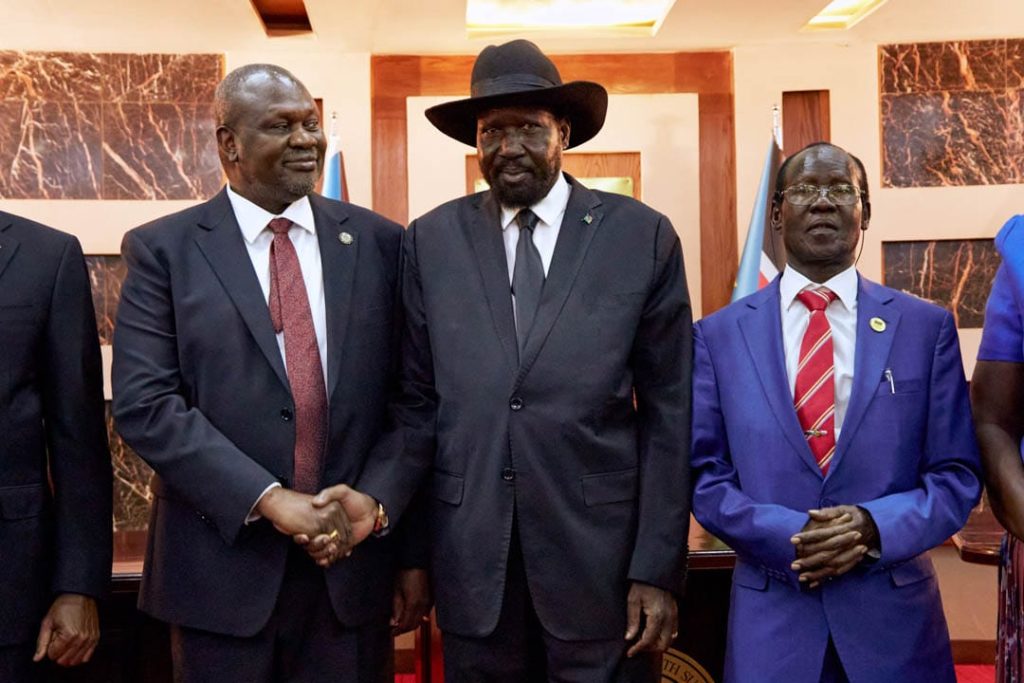
South Sudan will from August 22 have exactly one month to decide whether to hold a partial election, extend the life of the transitional government or not hold elections at all.
For the country to hold elections on December 22, 2024—the date announced by the National Elections Commission (NEC)—the transitional government and parliament must be disbanded by September 22.
Section 16 (2) of the National Elections Act, 2012 as amended provides that “upon announcement of the date of elections by the commission, the President, shall within three months to the election date, dissolve the National Legislature, State Legislative Assemblies, the National Government, and State Governments.
It is only the President, the First Vice President and four Vice Presidents are to remain in their positions and are allowed to remain in office until the new government takes over, according to Section 16 (4) of the National Elections Act, 2012.
On July 5, 2024, the NEC Chairperson, Prof Abednego Akok Kacuol exercised his constitutional obligations in the discharge of legal processes governing general elections in the country and subsequently announced the election date in South Sudan to be December 22nd 2024.
This is in pursuance to the provision of section 16 (1) of the National Elections Acts 2012, which provides that “whenever an election is to be held, the commission shall determine and announce the date per the constitution and publish it in the official gazette or two newspapers of nationwide circulation and on the commission website and mass media.
This notice should be at least six (6) months before the date of elections”. This has been done and considered running the electoral countdown.
This means that if there are going to be elections on the aforementioned date, then the partial legitimacy of the government will end on September 22nd, 2024, which is precisely one month from today (August 21).
The President is by this legal obligation expected to dissolve the government at all levels on the same date, except the Presidency.
On the other hand, if there are no elections to be held as announced by the Chairperson of NEC due to political decisions, then the political forces and other relevant stakeholders must urgently reconvene a new political dialogue to come up with a new political order for the sake of legitimacy.
This could be the basis for extending the life of the current transitional government for an agreed period. Only section 57 (1) of the National Elections Act 2012 mandates NEC to postpone elections if it becomes impossible to conduct the election on the provided date.
Election can be postponed if the security and sovereignty of the country are under threat, in case of a state of emergency.
According to Article 189 of the Transitional Constitution of the Republic of South Sudan 2011, provides that the NEC shall fix a new date for elections as soon as possible, which shall not exceed sixty days from the original date established for such elections.
Therefore, the postponement of elections, if any, is squarely a responsibility of the parties to the Revitalized Agreement on the Resolution of Conflict in the Republic of South and other stakeholders and not the NEC.
Once there is a consensus among the political players, then it shall be subsequently incorporated into the constitutional amendments and electoral governance calendar for the government to hold the general elections in the country.
Beny Gideon Mabor is the Undersecretary for the Ministry of East African Community Affairs, and this review is solely that of the author.