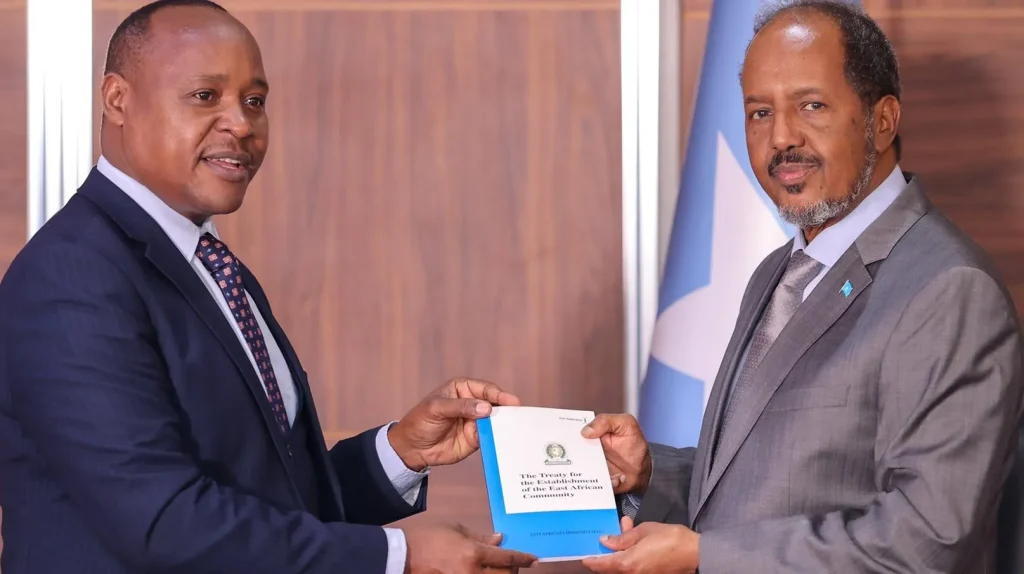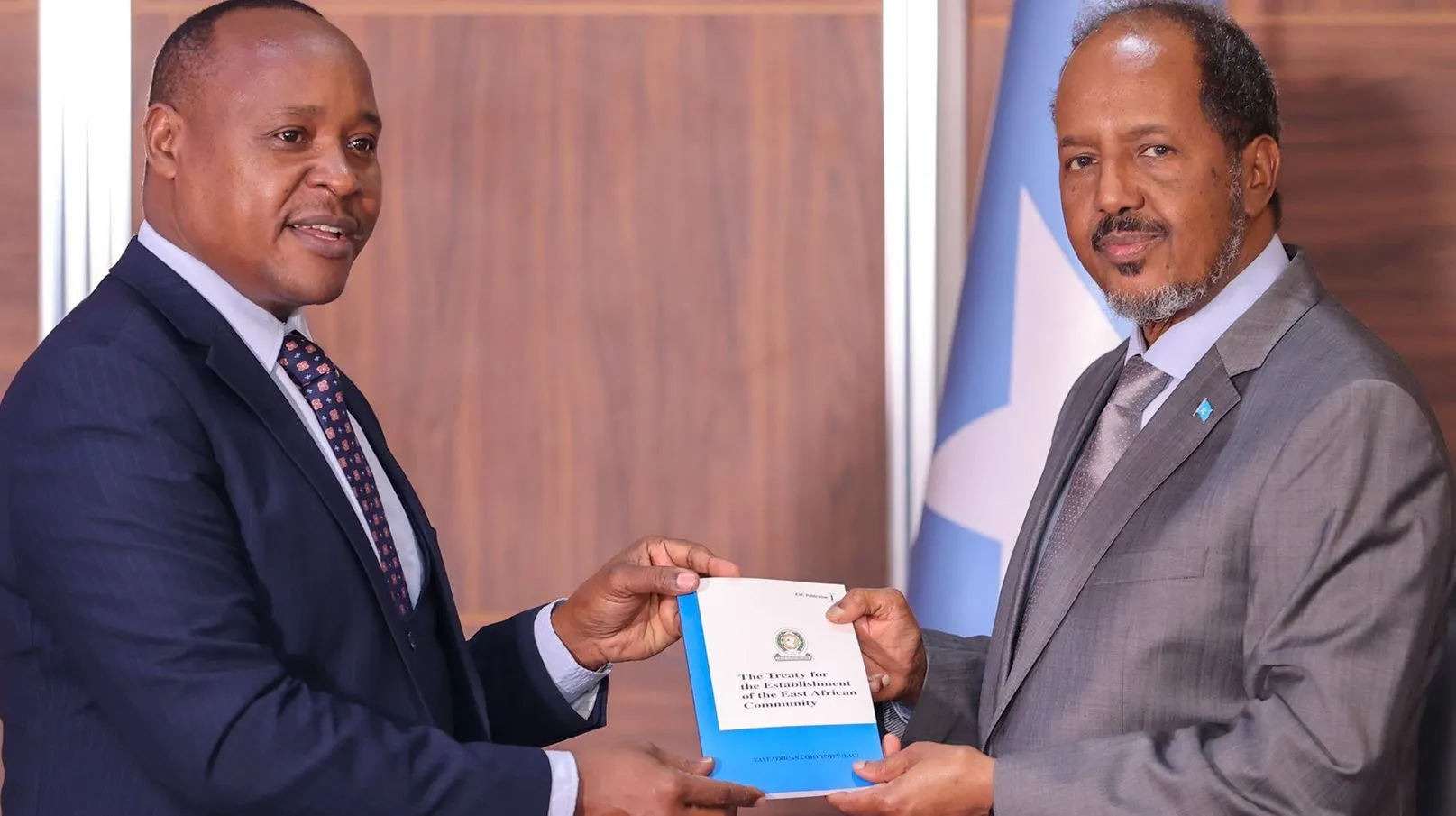
Somalia was officially admitted to the East African Community in March 2024 with a mixture of fortunes for both the country and the regional trade bloc.
But one thing is clear, Somalia has joined the EAC with a zeal to make good of the community offers and is taking steps that have since bypassed the Democratic Republic of Congo (DRC) which joined two years earlier than Somalia.
The country has made great progress towards regional integration since entering the EAC, which might have a major positive impact on the country’s infrastructure and economy.
Among the key achievements include; Somalia has started the process of bringing its legal systems into compliance with the EAC’s guidelines. Its complete membership in the Customs Union and Common Market, which permits the unrestricted flow of people, products, and services throughout the area, depends on this.
For Somali enterprises, joining the EAC offers a bigger market as well as a chance to draw in more foreign capital. Somalia hopes to strengthen its infrastructure and maybe increase its status as a regional transportation hub by joining the EAC.
To better meet the needs of the contemporary economy in the EAC, Somalia is concentrating on improving the technology and vocational training of its workers as well as its educational system. This involves putting into practice initiatives like the Draft Labour Code and the Decent Work Country Program, which seek to improve employment prospects and strengthen labour rights.
Top of it all, Somalia has developed a comprehensive roadmap that outlines all of the necessary procedures for both national and local initiatives to be completely integrated into the EAC.
This entails coordinating laws, policies, and rules to guarantee seamless integration and engaged involvement in EAC. The roadmap will allow the implementation of required policies and harmonise its laws to enable it to join the region’s Customs Union and common market protocols.
According to the EAC Secretary-General, Veronica Mueni Nduva, the roadmap will allow Somalia to align its legal framework with established regional standards and ensure robust participation in EAC programmes and activities.
Being an EAC member gives it access to a wider market, opening up opportunities for international commerce and investment, as well as an almost 20 million-strong market.
On the other hand, Somalia is working hard to prove that it is not just bringing problems of insecurity into the EAC, but tangible economic and social benefits to the regional trade bloc.
In April, the country held the first Somalia International Investment Conference in Mogadishu which provided a platform for the Somalia government to showcase investment opportunities, sectoral studies, and the general business and investment climate in Somalia to the region and world.
At the conference, Prime Minister Hamza Abdi Barre called on both local and foreign investors to take advantage of the existing opportunities which include the debt cancellation by international financial institutions which is a major boost as the country continues with economic recovery after a three-decade-long conflict.
Under the theme; Somalia: The New Frontier for Entrepreneurship and Investment, the conference showed its potential in telecommunications, tourism, agriculture, and renewable energy.
Its lush land provides the perfect environment for farming, with the ability to feed both the local populace and the surrounding area. With the longest coastline in Africa, Somalia offers chances for the growth of a prosperous marine sector.
This presents great potential for a blue economy for other EAC members, given that Somalia is situated in a very important part of the region; it connects the Indian Ocean with the Red Sea.
The country boasts a youthful population, a strategic position, and an abundance of natural resources, including fisheries, gas, and oil. The World Bank projects that Somalia’s economic growth rate will reach 4.3 percent by 2028, having climbed from 2.2 percent in 2022 to 2.8 percent in 2023.
Somalia’s Ambassador to Kenya, Jabril Ibrahim Abdulle says that Somalia is a country of entrepreneurs and EAC should expect Somalia to bring along the spirit of entrepreneurship.
Somalis have previously established themselves in East Africa, even before they joined the EAC, and they currently control several industries in Kenya, South Sudan, Uganda, and Tanzania.
However, full integration takes time given that it is a complex process and time-consuming, with challenges related to harmonising laws, policies, and regulations. Full membership requires political will, economic alignment, and significant institutional and infrastructural development to meet EAC standards.
Both the Somali Lower and Upper Houses will have a busy time to harmonise the law before the term of President Hasan Sheikh Mahmoud ends in 2026—given that he would like to see Somalia firmly embedded in the EAC having started the process of accession during his first term in 2012.
Fred Oluoch is a veteran journalist and a Senior Analyst on governance issues in The Horn and the Great Lakes. Contacts; frdoluoch@gmail.com