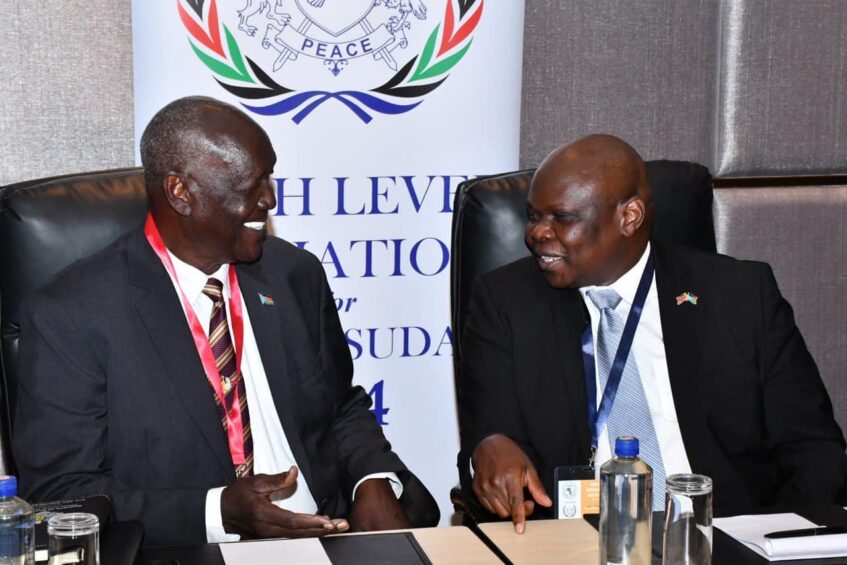

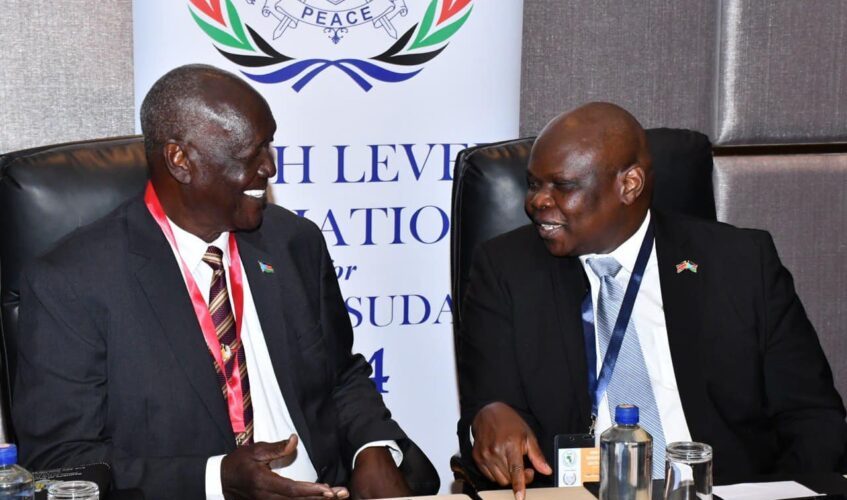
The South Sudan Tumaini Peace Talks in Nairobi were adjourned indefinitely to allow the government delegation to attend the official opening of the two-year extended transitional period, which begins on February 22.
However, the talks that involve the government of National Unity (TGoNU) and the opposition United People’s Alliance (UPA) have made two major achievements. The delegates agreed to adopt the previously agreed eight protocols and identified seven causes of conflicts in South Sudan since 2013.
In a communique issued on February 9, Chief Mediator Gen Lazaro Sumbeiywo said that the government delegation had requested an adjournment to return to Juba, but the Mediation had identified three priority areas critical to ending the perpetual transition in South Sudan
“These priority areas are: the unification of forces and security sector reforms; the permanent constitution-making process, and the holding of free, fair, credible and transparent elections,” said Gen Sumbeiywo.
One of the key achievements since the talks resumed on January 20 is the conclusion of the discussion on the root causes of South Sudan’s conflict and the formation of a joint committee to further break down the causes and suggest solutions.
Since the civil war broke out in December 2013, a number of opposition leaders such as Gen Thomas Cirillo of the National Salvation Front (NAS) have maintained that without addressing the root causes of the perennial conflicts, the country would never know peace.
The seven causes singled out by the Tumaini delegates include; the crisis over the Governance System; Power Struggle; Structural and Institutional Weaknesses; Economic Crisis and Resource Mismanagement; Insecurity and Militarisation of Society; Lack of Social Cohesion and Historical Injustices, and External and Geopolitical Influences.
The talks also agreed to adopt the eight protocols that had been signed by the disbanded government delegation and the opposition in May 2024, despite some personalities close to President Salva Kiir having pushed for their reopening for fresh discussion.
Gen Sumbeiywo said that the eight Tumaini Protocols were developed through a process of sustained negotiations and had been agreed upon by the Parties and Stakeholders, and the only remaining protocol is Power-Sharing commonly referred to as Responsibility Sharing.
These protocols include; Trust and Confidence Building; Permanent Ceasefire, Security Arrangements and Reforms; Humanitarian Access and Support; Communal Conflicts, Armed Civilians, and Land Disputes; Economic Recovery, Resources, and Financial Management Reforms; Justice Sector Reform, Transitional Justice and Accountability; and Permanent Constitution Making Process.
However, the government delegation left for Juba without concluding the most sensitive issue—how to blend the outcome of the Tumaini Initiative and the 2018 peace agreement, officially known as The Revitalised Agreement on the Resolution of the Conflict in the Republic of South Sudan (R-ARCSS).
While the government delegation, through rapporteur Dr Martin Elia Lomuro, maintained that they were going to Juba to prepare for the launch of the extended transitional period on February 22, those close to the mediation say that Juba is still not comfortable with Tumaini becoming a stand-alone agreement that UPA is demanding.
The parties to the 2018 peace agreement had in September 2024 opted for the extended transitional period after postponing the general elections that were initially scheduled for December 2024, claiming a lack of progress on important tasks required to ensure free and fair elections.
Edmund Yakani, the Executive Director of the Community Empowerment for Progress Organization, said that the relations between R-ARCSS and Tumaini Consensus are the main factor contributing to delays in reaching political consensus.
According to Mr Yakani, historical grievances and a lack of political will to make significant transitional progress in the best interests of the populace, have a significant influence on the political dynamics of the parties at Tumaini and South Sudan at large.