





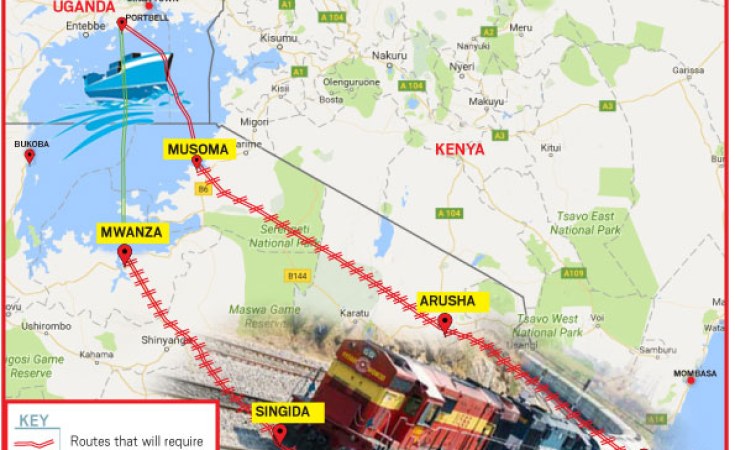
The African railway network—the most reliable inter-African link is once more getting the attention of former colonisers and those involved in the new scrabble for African resources.
A keen look at the railway system in Africa is that the colonial governments all over Africa constructed railway network from the source of minerals and other commodities o the port of export, but not to improve transportation infrastructure for the African people.
Currently, the two leading economic powers—the United States of America (USA) and China are increasing their focus on railway infrastructure investments targeting Sub-Saharan region that paves ways for their industrial economic developments abroad.
Countries like Tanzania which strategically acts as crucial gateway for many of their neighbours is one of the targets. The question is whether the US/China interests in the railway in fracture is for the benefit of the locals or an avenue for exporting raw minerals?
China’s recent $ 1 billion proposals for rehabilitating the Tanzania-Zambia Railway Authority (TAZARA) railway line is countered by the United States government’s commitment to funding a separate railway line connecting Zambia to Angolan port city of Lobito which is located to the west on the coast of the Atlantic Ocean.
This is the famous Lobito corridor which has actually become a subject of debate in recent years among stakeholders in mining sector whereby the US government consider it as a safe transport corridor for mineral resources.
In Tanzania, critical mineral resources such as copper, Nickel and cobalt which are essentials for both the energy transmission as well as for manufacturing of the world’s communication devices such as the smart phones, are in plenty.
Two companies, Singapore’s Trafigura and Canada’s Ivanhoe Mines, recently signed a deal to export copper from the rich region of Katanga province in Democratic Republic of Congo (DRC) using the Lobito rail route in Angola to global market.
This agreement marks a significant milestone development for the corridor, which stretches across Sub-Saharan region from the Angolan port city of Lobito to the DRC’s copper-rich Katanga province located in eastern part of the country.
The USA has committed to funding the construction of the entire 1,300 kilometer railway line with a view to explore options with multinational lenders to further expand the project into Tanzania, potentially creating a transcontinental connection between the Atlantic and Indian Oceans.
This development can be seen as part of a wider geopolitical competition between the US government and its allies the Chinese government. The two giant nations are currently vying for trade influence in Africa in order to explore mineral investment opportunities available for their industrial developments.
China has been actively investing in African infrastructure projects, often in exchange for mineral access. Likewise, the US government through the same initiatives, seems to be adopting a similar approach and make use of the Lobito corridor for alternative development partnerships to African nations.
However, the governments of Tanzania and Zambia believes that the long stretched railway line that links the two countries from Dar es Salaam commercial city in Tanzania to Kapiri-Mposhi in central province in Zambia, has economic importance for two countries.
The 1,860 Km stretch of a railway line also known as TAZARA was built by Chinese government between 1970 and 1975 is strategically and geographically positioned in an advantageous location for the smooth movement of minerals from DRC and Zambia to global market through Dar es Salaam port bordering Indian Ocean waters.
The authorities of both governments are optimistic that the TAZARA railway remains the shortest route for the transportation of raw materials to their final destination which is mostly in the Far East country of China.
According to TAZARA Managing Director Bruno Ching’andu,
the opening of Lobito line will bring about competition which in turn could result into efficiencies in operations. ‘The focus of TAZARA was on leveraging existing strengths, partnerships and infrastructure,” Said Mr Ching’andu.
The aim is to ensure that the authority remains a viable and competitive option in the transportation of critical minerals from Katanga rich zones in DRC.
Furthermore, Mr Ching’andu says that, TAZARA has embarked on the revitalization of the infrastructure and the provision of new rolling stock with the Chinese which will increase reliability and improve transportation as well as the delivery of goods to final destination points.
He believes that the initiative would attract an increased number of neighboring countries moving their cargo through the railway linking Tanzania and Zambia.
The spokesperson of US-Embassy Office in Tanzania Kalisha Holness said that the development of Lobito Corridor and Tazara Railways revitalisation represent a historic opportunity to build Africa’s first trans-continental railway linking Dar es Salaam in the east to Lobito in the west.
“This would unlock tremendous economic growth and development potential across Tanzania, Zambia and Angola, therefore benefiting citizens of all three African nations,” she said.
The construction of the Lobito Corridor and the revitalisation of the TAZARA line as complementary transportation projects that will be stronger and more beneficial because it will establish Africa’s first trans-continental railway link.
According to her, the recently signed US-Tanzania Commercial Dialogue and promotion for the expansion of US investments in energy, mining, ICT, tourism and other sectors will further economize national developments.
An economist from the University of Iringa in Southern Highland Region, Prof Enock Wiketye said that the two countries of China and US were actually struggling to win the continent’s market and abundant natural resources which is within for their industrial processing goods.
Prof Wiketye is of the view that, the US government has seen how China is conquering the continent after Beijing’s penetration in southern Africa region covering the whole of SADC region—which could threaten American interests.