

By FRED OLUOCH
The year 2025 marked the time when South Sudan’s President, Salva Kiir, initiated the process of killing the implementation of the peace accord and the dangerous path towards renewed large-scale conflict since 2018.
President Salva Kiir’s continuous reshuffling of top government officials, ranging from the vice presidents to top military officials, to the Central Bank governors, has not only kept the country in perpetual political uncertainty but is a threat to the fragile economy.
There have been debates on whether there is a cabal that influences President Kiir in his regular and unexpected reshuffles if he casually revokes appointments on an impulse.
However, the SPLM Secretary for Political Affairs and Mobilisation, Bol Makueng Yol, defended frequent leadership changes, saying they are within the party chairman’s authority and part of a “strategy” to solve national problems.
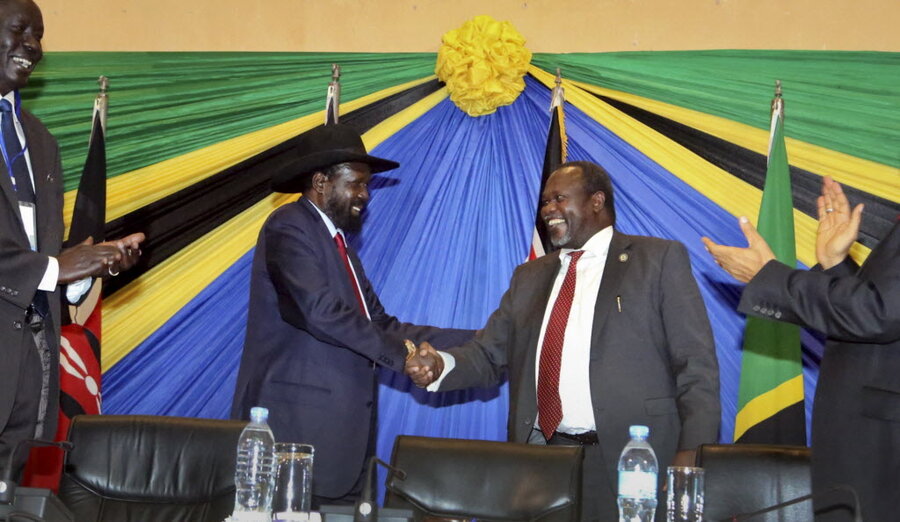
Yet, the biggest threat to the survival of the 2018 peace agreement, officially known as the Revitalised Agreement on the Resolution of the Conflict in South Sudan (R-ARCSS), occurred in 2025 when the first vice-president was placed under house arrest and subsequently charged in September. The arrest of Dr Machar destroyed the last remnants of trust in the coalition government.
Dr Machar’s trial has led to a virtual breakdown of political power-sharing, where SPLM-IO ministers were sidelined, the Joint decision-making committees stopped functioning, and as Kiir’s inner circle concentrated power in the presidency.
Since fighting broke out in Nassir, Upper Nile, in March between the South Sudan People’s Defence Forces and the White Army militia allied to SPLM-IO, other localised violence returned across several states in Upper Nile, Jonglei, Unity, and Greater Pibor.
Many clashes were triggered by competition for resources, revenge killings, and militia politics, but were often linked to national elites, as government-aligned militias and breakaway SPLM-IO factions re-armed.
The events in 2025 offer a dim view of the country’s capacity to hold credible elections on December 22, 2026, as set by the National Election Commission (NEC). This is because voter registration, constituency demarcation, population census, and legal amendments are important tasks that are yet to be completed.
According to Gen Thomas Cirillo, the leader of the National Salvation Front (NAS)—that is still fighting the government in Central and Western Equatoria- it is going to be difficult to hold genuine elections in one year’s time under the current circumstances.
“We don’t trust President Kiir and his regime to conduct credible elections. However, if President Kiir decided to have elections, it would be only to use the elections to give legitimacy to themselves to continue ruling,” said Gen Cirillo.
In their last meeting of the year on October 28, the African Union (AU) Peace and Security Council expressed grave concern about the current political and security situation in South Sudan and the tendency to relapse into violence.
The meeting requested that the Chairperson of the AU Commission appoint an AU High Representative to support the implementation of the outstanding aspects of the Revitalised Peace Agreement, and also to further enhance the institutional capacity of the AU Mission in South Sudan before the end of 2025.
The Security Council strongly demanded that the parties to the conflict set aside their differences and parochial interests, prioritise the supreme interests of their country and people and give peace a chance, to end the untold suffering facing the people of South Sudan, and work towards a full restoration of a democratically elected civilian-led government.
According to Puok Both Baluang, the Press Secretary in the Office of the First Vice President, the political, security, and economic catastrophe that South Sudan experienced in 2025 “were entirely man-made”. He said that the arrest of Dr Machar and seven others proved to be the ultimate breaking point.
The eight are facing charges of treason, murder, crimes against humanity, destruction of public property and financing terrorism. The charges stem from an alleged militia attack on a military base in Nasir, Upper Nile State, in March 2025. President Kiir’s government claims the attack, which killed over 250 soldiers and a general, was ordered by Machar.
“The root causes lie in the absence of genuine political will from President Kiir and his party’s leadership, which led to the abrogation of R-ARCSS. Other factors, such as the incursion of Ugandan forces and other alien groups into South Sudan to fight in severe violation of the UN arms embargo and the Cessation of Hostilities Agreement, have exacerbated this situation,” said Mr Baluang.
Both the AU Peace and Security Council and the Inter-Governmental Authority on Development (Igad) have acknowledged the difficulties facing the transition process in South Sudan, but maintain that there can be no sustainable military solutions to the present challenges facing the country.
