


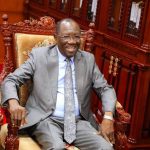


The Director General of the European Union (EU) Directorate for European Civil Protection and Humanitarian Aid Operations (ECHO), MACIEJ POPOWSKI, was in Kenya after visiting Somalia. He speaks to FRED OLUOCH about the EU humanitarian work in the eastern African region and the continent.
This month, the EU humanitarian office is celebrating 25 years of regional presence. What are some of the milestones the EU can boast of?
We mark 25 years of humanitarian assistance I manage from my office in Brussels. We have regional offices in Somalia, Ethiopia, South Sudan and recently Sudan, but the Kenyan office oversees operations in the east, central and southern African regions.
It is not only looking at country situations but regional issues like the mass movement of people, disasters, famine, and conflicts—we have some experts advising on food assistance and health. It is quite big 144 staff members, both international and Kenyans.
Has EU humanitarian operations made a difference in the region?
It is difficult to quantify but we have made a difference in the number of people who need assistance that we have reached. We are here to assist people in need, as you know how volatile the region is—Somali, Ethiopia, Sudan, South Sudan.
What attracted the EU to the eastern African region as opposed to other African regions?
When I look at our engagement worldwide, Africa has been traditionally the centre of gravity because of the challenges. But we are everywhere in Haiti in Afghanistan. Still, our presence in Africa is pretty big because of mass movement from the south to the north and vice-versa.
Many Europeans think that the movement is only from the south to the north but there is much more movement from the north to the South. We thought it would be good to have a regional hub, Nairobi is well connected and is the seat of many UN agencies who are closest partners.
You have just returned from the war-torn Somalia. Can you describe the humanitarian situation there and what remedies has the EU put in place in terms of humanitarian assistance?
It is pretty bad because we combined the impact of the conflict and the huge floods that will be followed by drought. There are over 7 million people on the move who need humanitarian assistance like food, medicine and income assistance.
We prefer cash assistance through their mobile phones which empowers them to make their own decisions on whatever they need and not us to decide for them.
I went to a refugee camp Baidoa refugee camp in South West state and there are about five families arrive every day fleeing from Al Shabaab with several children who are severely malnourished.
We fund our partners, WFP or the Norwegian Refugee Council who operate mobile clinics. We are not solving the underlying problems because Al Shabaab is there and the government-controlled space is shrinking.
Does EU operations include livelihood support in Somalia?
Yes, we also provide livelihood support, but our action should be short-term. We have been in Somalia for about 30 years and our objective is short-term, and our real ambition is to make our redundant so that we can leave.
What is the EU budget for Somalia this year and is it sufficient?
It is never sufficient. We started this year with 40.1 million Euros and there is a need for a top-up. Last year we spent 92.4 million Euros in Somalia. I will look at our books again once I go back to Brussels because we need a top-up. Otherwise, we will reduce the number of our operations thereby reducing the number of beneficiaries, which is not good.
The EU has responded to almost all the big crises that have hit this region over the last two decades in Somalia, South Sudan, Sudan and DRC. What has been the impact?
We believe that we have because if it were not for our assistance, a lot of more people would have suffered or died. It is not always good to see people stuck in refugee camps.
Eastern DRC is the worst. Last year I went to Goma and I witnessed people who completely depend on the support of the international community. The M23 are hiding in the Virunga National Park but are causing more displacement to Goma town. We have funded a water pipeline from Lake Kivu providing for the refugee camps in Goma and that is the much we can do.
After 25 years of presence, would you say that the EU has transferred expertise on emergency response to the local population so that they can respond to disasters on their own?
In Kenya, we managed to limit our existence but we still assist with refugee camps in the north—Dadaab and Kakuma. It is about $12 million a year. But in many countries, we are not able to disengage. We call it graduation in our jargon when countries can stand on their feet.
But unfortunately, it doesn’t happen quite often. When you look at Somalia, South Sudan and Ethiopia, we have not been able to disengage because of persistent conflict. It is only in Mauritania—where we were quite big in the 1990s—but we were able to disengage when the country became stable.
Now we are forced to go back to Mauritania not because of any problem in the country but because of refugees from neighbouring Mali. There are about 120,000 refugees from Mali and the Mauritania government is not in a position to take care of them and they reached out to us for help.
Is the EU having donor fatigue because of persistent conflicts in Africa?
There is no fatigue. The recent opinion polls showed that close to 90 percent believed that we should continue in our role as a major donor. People are convinced that we should continue because it is the right thing to do. We are the second largest donor after the US. Sometimes we are overtaken by Germany. Sometimes when something big happens like in Gaza, the world’s attention often turns.
But it is not in our case. For us there is no such thing as “forgotten crisis”, we remain engaged everywhere. But we feel the pressure as well, the budget for humanitarian is slowly going down worldwide and we are desperately seeking for new donors. However, there aren’t many takers.
So, have the wars in Ukraine and Gaza impacted on your operations in Africa?
Not much. We were able to scratch the barrels of the EU reserves to deal with Ukraine without touching anything that was earmarked for Somalia and Africa in general.
How has the EU humanitarian response changed in the face of climate change?
It is much worse. Maybe climate change was already happening 25 years ago and nobody paid attention. Now it is exacerbated. flood and drought. We are more concerned in providing food and water, shelter but we are focusing on prevention, which is cheaper than response.
There is a common perception that the world has turned away from Sudan. What is the EU response to Sudan’s situation?
We are struggling in Sudan. We had to evacuate our staff, some of the international collogues are in Nairobi. Khartoum is pretty dangerous and maybe if we are lucky, we might go and establish ourselves in Port Sudan. The country was in focus until Gaza hit and everybody turned away. But for the EU, there is nothing like a forgotten crisis
Xxxxxxxxxxxxxxxx
BIO
MACIEJ POPOWSKI
Education
1983 to 1988: MA degree in German and Dutch language and literature University of Wroclaw – Wroclaw, Poland
1991 to 1992: Diplomatic Training Course from Aus- und Fortbildungsstätte des Auswärtigen Amtes, Bonn, Germany.
Employment
· Since March 2023: Director-General – Directorate General European Civil Protection and Humanitarian Aid Operations (DG ECHO)
· 2016 to 2023: Deputy Director-General – the Directorate of Neighbourhood and Enlargement Negotiations (DG NEAR)
· 2011 to 2015: Deputy Secretary-General – European External Action Service, (EEAS) – Responsible for Common Security and Defence Policy.
· 2009 to 2011: Head of Cabinet of European Parliament, responsible for policy coherence, aid effectiveness, aid financing, relations with other donors, and public communication.
· 2003 to 2008: Ambassador – Permanent Representation of the Republic of Poland to the EU, Brussels, Representative of Poland to the Political and Security Committee


