

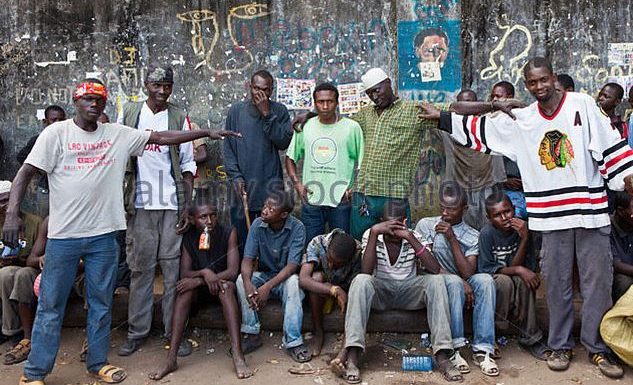
Kenya is experiencing a resurgence of organised gangs that were banned 20 years ago, but are back because of the divisive ethnic-based politics.
A new report by ENACT-Africa wars that the country could find itself in a situation where it would not control the gangs, especially in the current charged political atmosphere and the downturn in the economy.
In a report: Criminal gangs and elections in Kenya released on April 20, ENACT-Africa say that the government should dismantle organised criminal gangs and militias and prosecute their leaders and funders.
ENACT Africa is a think tank that seeks to enhance Africa’s response to transnational organised crime and mitigate against negative impacts on development, governance, security, and the rule of law. ENACT is implemented by the Institute for Security Studies in partnership with INTERPOL and the Global Initiative against Transnational Organised Crime.
The report says that Kenya is grappling with six types of gangs; criminal gangs; Politicians gangs that manifest themselves in political party militias; ethnic militias that are out to defend their ethnic kingpins; the matatu enterprise gangs that fleece operators of public transport; coastal gangs that thrive on the land ownership in the southern region of the country, and the Oromo Liberation Front (OLF)—the Ethiopian secessionist movement found in the cross-border regions of factor Marsabit and Moyale.
“Those seeking political positions create or finance violent groups – organised criminal gangs and ethnic militias – to propel them to power, thus turning violence into one of the tools that determine the course of politics in the country,” says the report that was funded by the European Union (EU).
The report says that nine out of ten organised criminal gangs are involved in politics. Among the gangs at the politician’s beck and call are Godfather, Yakuza, Gaza, Portmore, Kianda, and Kayole Kona Mbaya, all based in Eastlands. These six gangs together employ about 1,000 young people who benefit directly and indirectly from terminals under the gangs’ control.
Top on the list is the resurgence of the Mungiki Militia—an extortionist gang found in the Mt Kenya region—that Kenyans thought was annihilated during the reign of Mwai Kibaki from 2002 to 2013.
The Mungiki gang that unleashed ethnic violence across the country after the 2007 poll, is back in a subtle way collecting illegal taxes openly in the matatu stages akin to Al Shabaab taxation by Somalia militias.
But those in public transport are scared to point them out due to fear of losing their ability to operate in certain routes or more, their lives. They assault drivers accusing them of paying their daily toll of $3.
They not only attack “defaulting” Matatu crew while on duty but they also time them in their residential estates and attack them when they go to buy items at nearby kiosks. Some pay a weekly fee of $20 to keep their families safe because they have all the intelligence from rogue police.
The rank and file earn between $4.3 and $8.6 each a day depending on the sensitivity of the beat and the inherent risk. “While the money flow may be constant during the election period, once the election is over the gang members go back to the matatu. Politicians involved generally make about $3,000 a day from roughly 34 matatu terminals controlled by the gangs in Eastlands,” the report says.
A Human Rights Watch report after the 2007 post-election violence blamed the group for reprisal attacks in Nakuru and Naivasha that targeted non-Kikuyus. Reports at the time claimed the group had infiltrated the police with support from influential politicians from the Central Province to help clamp down on anti-government elements.
With the ongoing dispute between President William Ruto and opposing leader, Raila Odinga over the August 2022 elections, the Mungiki from Central—that supported President Ruto—have emerged to counter street protests organised by the opposition.
The report lists the gangs in Nairobi as; the Kenya Youth Alliance (extortion, informal security services, political hire), Kamjesh (matatu extortion) Yes, We Can (informal security services, extortion, political hire, informal water, and electricity connection)
Then there is the Taliban (matatu extortion, political hire, informal security services), Kamukunji Pressure Group (informal security services, political hire, informal water, and electricity connection), Al Safa (political hire, informal security services)
In Kibera, the biggest slum in Nairobi and a stronghold of Mr Odinga, there are the Nubians (informal security services), Kibera Battalion (extortion, political hire, violence), J-10 (extortion, informal security services, political hire, informal water, and electricity connection), Siafu (political hire, extortion, informal water, and electricity connection)
Then there is the Super Power (gun trafficking and organized armed heists, theft, burglary) Gaza (gun violence, general violence, informal electricity connection), Usiku Sacco (matatu extortion, political hire, muggings, and burglaries), and Congo Boys (political hire, informal security services, street robbery, and burglary
Interviewees indicated that politicians across the board used these gangs in the August 2022 election. Not only do they depend on them to vote for them, they also provided bodyguards, voting agents, and ‘goons’ who disrupted rivals’ rallies and destroyed campaign materials.
“Some of the criminals are now fully involved in politics, providing security and mobilisation services to politicians seeking elective seats. That is scary, especially in a situation where election results are disputed at the ward, county, or constituency level,” said Kamau, a Matatu driver in Nairobi who dint want to be fully identified.
In March, a group cited by the authorities as Mungiki, raided Mr Kenyatta’s farm, 20km from the capital Nairobi and carted away over 1,500 sheep on the incitement of politicians linked to President Ruto. The irony is that these gangs have no permanent loyalty. Maina Jenga, the founder and former leader of Mungiki is currently a strong supporter of Mr Odinga
Ethnic militias, among them Mungiki, Chinkororo from the Kisii region in western Kenya, Mombasa Republican Army, and Angola Musumbiji from Vihiga in the Western region, sprung up in the 1990s and continued to define the country’s politics till the 2007/8 post-election violence that saw a number of suspected militia financiers hauled before the International Criminal Court (ICC)—including president Ruto and former president, Uhuru Kenyatta.
During and after the 2007/2008 post-election violence, about 1,500 people were killed and 600 000 uprooted and displaced by gangs, militias, and law enforcement authorities from their homes.
The secessionist OLF has often crossed from Ethiopia into Kenya seeking refuge from the Addis Ababa regime. The tribe has been involved in a longstanding feud with the Gabra, its neighbour in Marsabit.
The dispute, whose origins lie in a battle for control over the pasture, has turned into a contest for political supremacy. The fact that Marsabit’s fourth-largest tribe, the Burji, which controls commerce in Marsabit Town, is barely involved in the conflict, suggests that the skirmishes are not about the control of economic resources but about political power.56 According to the Marsabit Diocese Anglican Bishop, Qampicha Daniel Wario, ‘What we know is that politicians are the ones who are financing this war.’
The report says that Politicians are bankrolled by wealthy business people in Marsabit Town to smuggle guns from Ethiopia through various points, but mostly Ele Bor (aka Ele Labor, Elle Bor), a militia camp in a hilly frontier spot in Sololo.68 Other militia camps are Elle Dimtu, Ambalo, Badan Rero, and Kubi Qalo
At the coast where land ownership is an emotive issue and a major cause of violence and thriving gangs, the National Cohesion and Integration Commission—with the mandate to preempt inter-ethnic flare-ups—identified 93 gangs in the counties of Mombasa, Kwale, and Kilifi.
The coastal region, specifically Mombasa, is seen as the cradle and home of juvenile criminal gangs, with the Mombasa Republican Council (MRC) pushing for secession through the slogan, Pwani Si Kenya (the coast is not part of Kenya). This group was driven underground but analysts say that with the resurgence of militias, they could as well emerge from the woodworks.
The report recommends a number of interventions such as the strict implementation of the Elections Campaigning Act of 2013 provide for the regulation, management, expenditure, and accountability of funds during the election; Kenya has many legal ways to arrest the culture of electoral violence, among them the Elections Act No. 24 of 2011, the Elections Offences Act No. 37 of 2016
Other recommendations are that politicians arrested for instigating violence must be prosecuted; banning gangs and the control of arms in the wrong hands. In September 2020, former Interior Minister, Fred Matiang’i estimated that there were 100, 000 illegal firearms in the county
According to Shanti Tasha, an activist for Counter Terrorism Policing the issue of criminal gangs has been around for a long time in Kenya and must be addressed.
“We have had successive presidents banning gangs but we find that we are still in the same predicament despite the efforts that have been done so as to curb the menace,” she said.

