

After diplomatic debacles involving Sudan, the Democratic Republic of Congo and Tanzania, the Kenyan Ministry of Foreign Affairs is now forced to issue regular quarterly diplomatic briefings to foreign missions to placate the country from a series of diplomatic blunders.
While the ministry maintains it is part of the William Ruto administration’s new approach to open up the Kenyan Foreign Policy for public participation, known as “Grand Strategy”, analysts say it is meant to block foreign missions from asking many questions in controversial cases.
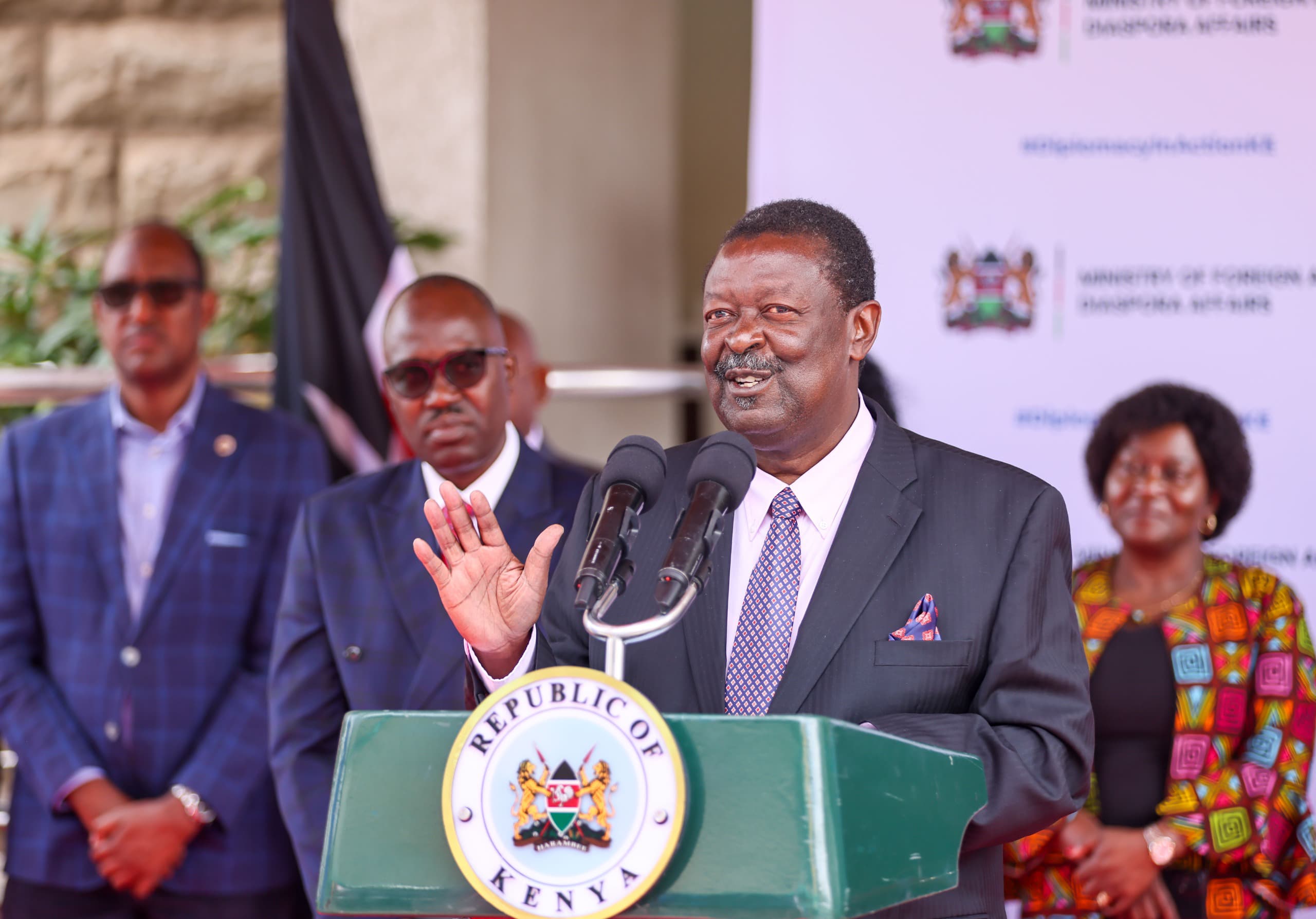
Prime Secretary, Musalia Mudavadi, who is also the Cabinet Secretary for Foreign and Diaspora Affairs, in an interview with Afroeconomist, said that Kenya’s foreign policy is now citizen-centred and transparent.
“We have changed from conventional and opaque international relations to transparent and accountable international relations,” said Mr Mudavadi
He argued that Kenya’s foreign policy shouldn’t be foreign to Kenyans. Thus, quarterly diplomatic briefings offer Kenyans a unique opportunity to follow Kenya’s diplomatic engagements, besides giving Ambassadors and High Commissioners clarity and context on issues of mutual and bilateral interests.
Mr Mudavadi said that real-time communications are useful in addressing and offering context on emerging national and international issues, while Quarterly Diplomatic Briefings take care of topical issues.
However, Mr Mudavadi avoided delving into the recent diplomatic goofs that have put the country’s foreign policy pursuit into disrepute, especially Kenya siding with rebels in DRC and Sudan, while Mr Mudavadi supported the deportation of six Kenyans from Tanzania who wanted to attend the treason trial of opposition leader, Tundu Lissu.
Mr Mudavadi’s latest quarterly diplomatic briefing was on June 25 over the protests marking the first anniversary of the Gen-Z protests in June 2024, when he wrote to foreign envoys saying that while the government regretted the killings and damage to property and widespread violence, the briefing blamed it on the protesters.
“The Ministry of Foreign and Diaspora Affairs wishes to update all Heads of Diplomatic Missions and international organisations in Kenya on the demonstrations and related violence witnessed in several areas of Kenya on 25th June 2025,” the briefing said.
“The rights envisaged in Articles 19 and 20 of the Constitution of Kenya are not absolute. Article 19(3) is explicit that the rights are subject to limitations contemplated in the Constitution. Article 24 outlines the general principles for limiting fundamental rights, including those in the Bill of Rights,” he wrote.
The Constitution of Kenya guarantees the right to assemble, demonstrate, and picket under Article 37, but limited to peaceful and unarmed actions.
Mr Mudavadi continued with the defence of the government, saying that the organisers bear the responsibility to ensure demonstrations remain peaceful, yet it remains unclear who organised these events and whether they fulfilled their legal obligations.
He wrote, “We must seriously ask ourselves: Who were the organisers of the intended peaceful demonstrations? Did they discharge their responsibilities as envisaged under the law?”
The briefing asked whether one should condemn the government for ensuring security and stability when critical institutions such as administrative offices and police stations are being set ablaze in the purported peaceful demonstrations.
A day before the anniversary, Western embassies, including the United States, the United Kingdom, Germany, and Canada, urged the Kenyan government to comply with a High Court ruling that banned the use of plain-clothed police officers in unmarked vehicles during protests.
Just like the previous cases involving the DRC, Sudan and Tanzania, the government received criticisms both locally and internationally for its high-handed reaction over the Gen-Z anniversary processions, which turned violent when the police insisted on dispersing them.
The biggest goof was in February 2025 when Kenya allowed Sudanese rebels, the Rapid Support Forces (RSF) and its 24 allied political parties and civil society to convene in Nairobi to establish a Sudanese parallel government.
In DRC, Kenya had a diplomatic tiff with the government of President Felix Tshisekedi in December 2023, when it allowed the launch of a Congolese rebel alliance in the capital, Nairobi.
The launch of a political-military alliance, the Congo River Alliance, involved Corneille Nangaa, the former head of DR Congo’s electoral body, and the head of M23, Bertrand Bisimwa.
The Ruto administration is basing its Grand Strategy foreign policy on five key areas: Promoting Pan Africanism, strengthening EAC integrations, resolving conflicts in the region, growing the economy, and embracing multilateralism.
However, opposition leader Kalonzo Musyoka, who is also a former long-serving foreign minister, said in an interview with a local TV station that Kenya’s diplomacy is currently “confused”.
He said that President Ruto’s administration has overturned the country’s foreign policy since its independence, where Kenya has always upheld the orientation of non-alignment and giving priority to South-South dialogue.
“I rejected when America designated Kenya as a non-NATO ally, which leaves the country exposed to elements like Al Shabaab that can now hit Kenya directly for siding with America. President Ruto has also decided to support Gen Mohamed Hamdan Dagalo of RSF against the Sudan government by allowing Kenya to serve as a conduit of arms to Sudan,” said Mr Musyoka.
However, Dismas Mokua, a Political Analyst, said Mr Mudavadi is probably the first office holder to engage envoys regularly, in an attempt to embrace transparency and accountability.

