

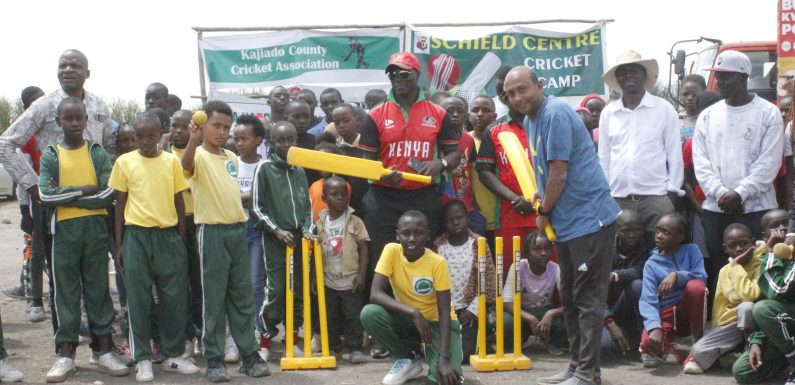
When Kajiado Cricket Association held a one-day sporting event at Schield Centre in Isinya in August, the sight of young boys and girls participating in cricket matches reminded one of the times when Kenya was on the cricket world map between 1996 and 2003.
The Kenya cricket golden days are over, but the Schield Centre in collaboration with former international players such as Ken Obuya, is determined to revive the game among the youth.
The Schield Centre held a one-day sporting event where youngsters ranging from 11 to 15 years, underwent elementary training in bowling, batting, and fielding using plastic bats and soft balls to try and revive the game that once made Kenya proud across the world.
Nairobi lawyer, Joseph Awino, who is the director of the Shield Centre—a school for underprivileged children in Isinya, Kajiado County some 58 km southwest of Nairobi—said his school organizes these events not only to popularize the game among the youth but also to give them a platform to interact and get mentorship and career guidance.
“It keeps the children occupied during school holidays and an opportunity for the students to showcase their talents in sports or singing,” said Mr Awino. Shield Centre, located 6km from Isinya Shopping Centre, was the venue where over 200 students from Isinya Primary, Kepiro Primary, and Musa Primary gathered to learn and practice cricket.
When minnows Kenya stunned the world by beating the Great West Indies in the1996 World Cup, it gave the impression that a new cricketing nation had been born.
However, the party did not last long as Kenya’s standards degenerated due to squabbles in the cricket governing body and the lack of a youth development programme to feed into the national team.
Now, cricket lovers are determined to revive the game through the youth throughout the country. Mr Obuya—who was part of the Kenya team that did very well at the ICC World Cup in 2003—is currently the Cricket Kenya Counties’ Representative.
He said that the standards have dropped since 2003, and Kenya which used to be a powerhouse in cricket is currently a pale shadow of its former self, with even Uganda which was nowhere on the map, overtaking Kenya in the region.
“It is our responsibility to see how we can spread to all the 47 counties. We are going around and introducing the game to schools and we have so far visited 25 counties where boys and girls have responded with enthusiasm,” said Mr Obuya, who was the guest of honour at the event.
The organisers believe that events offer opportunities to work with children through sports because it gives them purpose in life and gives them something to believe in apart from education.
Walter Mukinginyi, a former secretary of the Kenya Cricket Umpires Association—who introduced cricket at Schield Centre—said that the sports day event was one of the avenues to promote cricket in Kenya and it has to start with schools and the youth.
He said that cricket has always been seen as an elitist sport but they are determined to take the sport to the grassroots.
“Cricket is overshadowed by football because historically, cricket was a members’ club game that was played by clubs such as Impala, Nairobi Club, and Impala. But now we want to make cricket a sport of choice because it is a game that can be played anywhere in the estates and streets,” said Mr Mukinginyi
For a long time, cricket was played only in Nairobi and Mombasa, and to some extent in Kisumu. Cricket is a British game but was popularized in Kenya by the Indians who were building the Kenya-Uganda railway. So, naturally, cricket followed the railway line.
Cricket was introduced to Kenya in the 1880s after it had been brought under British influence. The first significant match occurred in December 1899 when the East African Protectorate took on the Rest of the World in Mombasa. The game has always been dominated by Kenyans of Indian stock while the rest of Kenyans believe that the game is elitist and expensive.
Kenya was able to participate in international one-day competitions after becoming an official associate member in 1981. Kenya was able to participate in international one-day competitions after becoming an official associate member in 1981.
Kenya also entered the World Cup in 1996, and from there they were eligible for every World Cup between 1996 and 2011. The 2003 World Cup is regarded as one of Kenyan cricket’s pinnacle moments. They reached the semifinals after defeating Sri Lanka and Zimbabwe.
The victory over Zimbabwe also guaranteed their place in the semi-final against India, where they lost by 91 runs to the eventual tournament champion.
While Kenya might not in the near future find players of the caliber of Steve Tikolo, Maurice Odumbe, and Mohammad Akram on the streets; instead, the country needs a proper cricketing structure to find the right talent and develop it into players who can compete at the highest levels.

