

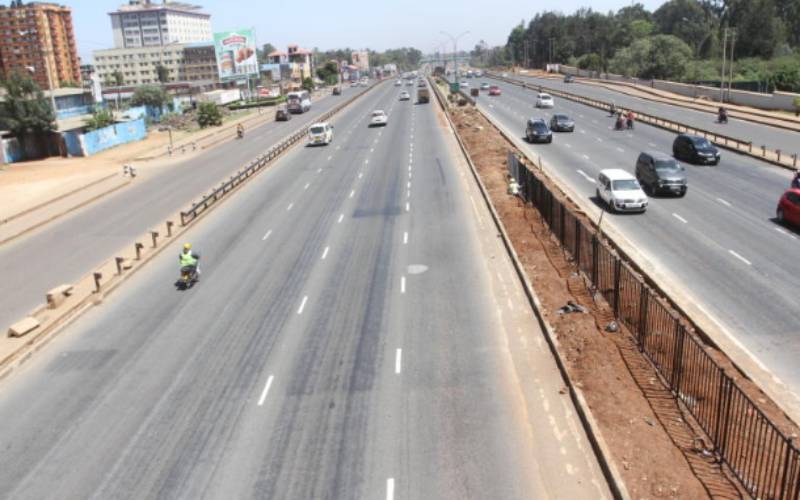
Navigating around Kenya’s major towns can be quite a challenge. Whether self-driving, riding on a private taxi, the bigger public commuter vehicles or a motorcycle (boda boda), or even walking on foot, one must contend with the lawlessness that rules the roads, putting every commuter’s life at a risk. Safe for the less crowding, this scenario is replicated everywhere in the country.
And for the laissez –faire attitude, the consequences are there for all to see….too many accidents that claim at least 3,500 people, and critically injure over 20,000 others on Kenyan roads annually. Pedestrians constitute the majority victims, according to the National Transport and Safety Authority (NTSA). NTSA says this year could be deadlier since the first quarter alone, from January to March, has seen at least 1,200 people killed on the roads, the highest toll since 2022.
It is particularly bad with the motorcycles. From riding on the wrong side, ignoring traffic lights, carrying excess passengers, not wearing helmets, to weaving between vehicles, before the very eyes of the law enforcement agents, the lot seems to be exempt from the traffic code. Yet Kenya has witnessed a surge in motorcycles following the zero-rating of their imports in 2008 to create jobs. The boda bodas remain a popular means of transport, but are notorious as a fatal attraction.
According to the World Health Organisation (WHO), more than 1.35 million people die every year on the roads globally, and another up to 50 million sustain non-fatal injuries as a result of road traffic crashes. Kenya contributes significantly to the numbers with a United Nations road safety meeting in 2022 ranking some of the East Africa state’s roads among the deadliest in the world. Although Kenya’s reported crash fatalities have been growing significantly over the last five years, WHO estimates suggest that the figures were under-reported and could be up to four times higher than official estimates.
Every major road crash in Kenya prompts a public outrage and voluble pronouncements by the officialdom. However, these are never sustained or followed with actions to remedy the situation. Transport Cabinet Secretary Kipchumba Murkomen says the outrage is often short-lived because some passengers often contribute to the road accidents.
“In this country, when one accident happens, there is usually a short public outrage and Kenyans cannot sustain that outrage because it is the passengers who are also contributing to this madness,” the CS said.
But the biggest blame must surely go to the government. The construction of the roads of the required standards, their regular maintenance and the uncompromised enforcement of the traffic code, are responsibilities the government cannot run away from. In Kenya, as in other low and middle-income countries, rapid increases in human and vehicle populations, which have in turn led to rapid increases in traffic, remain major problems. Many road users regard the NTSA and police officers manning the roads as bribe seekers, with least interest in ensuring travel discipline. So, anything goes for anyone willing to offer a bribe on the roads.
It is a no brainer that sustained enforcement of the traffic code can make a huge difference. When in 2004 no-nonsense Transport minister John Michuki, introduced stringent road regulations, hence the moniker ‘Michuki Rules’, road accidents reduced by 74 percent nationally. Fatal road crashes involving urban public service vehicles fell by a whopping 94 per cent in just three months. Two decades after the success of the Michuki Rules, implementation has ebbed to the barest minimum and accidents have become so rampant that the country is hitting the reset button.
Kaltum Guyo, a columnist with Kenya’s number one newspaper the Daily Nation, says the government must take the blame for not only failure to construct enough roads, but also do so in standards that keep motorists and pedestrians safe. Guyo further blames the government’s piecemeal solutions, such as speed cameras instead of a holistic approach.
It is instructive that senior state officials are among the most notorious road offenders. Legislators governors and Cabinet Secretaries, for instance, often order their entire entourage to speed on the wrong side of the road in the name of beating traffic snarl-ups.
President William Ruto on April 17, 2024 launched a five-year road safety action plan. Under the national vision of “safe roads for all users”, the plan targets a 50 per cent reduction in fatalities by 2030. This target is aligned with the timeframe of the Sustainable Development Goals (SDGs) and the Second United Nation Decade of Action for Road Safety 2021-2030.
Interior cabinet Secretary Kithure Kindiki says measures put in place include addressing the issues of motorcycles, retesting of drivers, revamping of the traffic department, increased patrols, cooperation with the Office of the Director of Public Prosecutions (ODPP) and judiciary, as well as revising of the Traffic Act-School Regulations of 2017 to include the age of the drivers, driving experience and conduct of the driver and their aides.
Realising the dream of “safe roads for all users”, and rising to the league of the nations with the lowest rates of road accidents, will definitely take a lot more effort. The starting point, pundits believe, must be the strict observance of the traffic code by all and sundry.
