

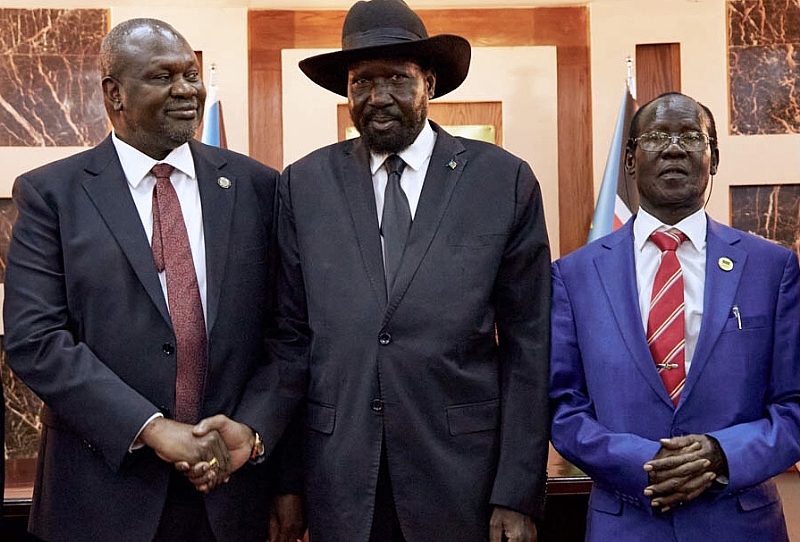
An agreement arising from the Tumaini Peace Initiative is on the verge of signing after six months of deliberations, though the ball is now in the court of the Kenyan government to set aside the date.
This follows a one-day trip of Kenyan President William Ruto to Juba on November 6 to assure his South Sudan counterpart that Tumaini is in the right direction after two months of stalling due to substantial spoilers within the government delegation.
Pagan Amun, the leader of the Real-SPLM and a key player in the talks, said that the negotiations are over, and it is now time to sign. He said President Ruto went to Juba to invite the government to the signing ceremony after which the process will move to the implementation phase and it is upon the government of Kenya as a convener to communicate the date.
Other sources within Tumaini have hinted at November 20, though the Kenya government could not confirm.
President Ruto was forced to travel to Juba to assure Salva Kiir after a huge rift with the government delegation for the last two months, with those opposed to Tumaini saying that the initiative had been hijacked by the Troika—the US, UK and Norway—and that it was likely to be used as regime change.
This followed concerns among the South Sudan Opposition Movements Alliance (SSOMA)—that remained in Nairobi after the government delegation travelled to Juba almost three months ago—that President Kiir had lost trust and interest in the Tumaini Initiative because of the strong opposition by some powerful elements within his government.
Edmund Yakani, Executive Director of the Community Empowerment for Progress Organization (CEPO)said that besides suspicion over the intentions of Troika, some people led by Dr Riek Machar’s SPLM-IO were pushing the narrative that Tumaini was meant to replace the 2018 peace agreement—officially known as the Revitalised Agreement on the Resolution of the Conflict in the Republic of South Sudan (R-ARCSS)
“It is not true that Tumaini is for the regime change which emerged from misinformation of the Tumaini spoilers. But President Ruto indeed has to convince President Kiir and Dr Machar that Tumaini is not undermining R-ARCSS and it is not replacing the government,” said Mr Yakani.
He added that some members of the government had even gone to the extent of lobbying the Inter-Governmental Authority of Development (Igad) heads of states and governments to reject the Tumaini initiative because it is undermining R-ARCSS.
Before his travel to Juba, President Ruto met with a South Sudanese delegation, led by Cabinet Affairs Minister Martin Elia Lomuro at State House Nairobi and set the stage for the visit
Presidential Press Secretary Lily Martin Manyiel Ayuel also refuted claims that President Kiir has lost interest in the Tumaini Initiative. Since its establishment in May, the Tumaini Initiative has agreed on nine protocols.
They include; Confidence-Building Measures; Communal Violence and Land Issues; Justice Sector Reforms, Transitional Justice and Accountability; Security Sector Reforms; Permanent Constitution Process; Economic Recovery; Humanitarian Access and Support; and Responsibility Sharing.
In a joint statement last week, Troika warned against a lack of political goodwill among leaders and asked South Sudan’s leaders to support the Tumaini Initiative in an effort to achieve lasting peace in the nation.
“The international community must be clear that we will not support a status quo that promotes the privileges of a few over the welfare of the people of South Sudan. We agree that the forthcoming extension period is essential for the transitional government to demonstrate to the international community and the people of South Sudan its commitment to implement the peace agreement,” the statement said.
