

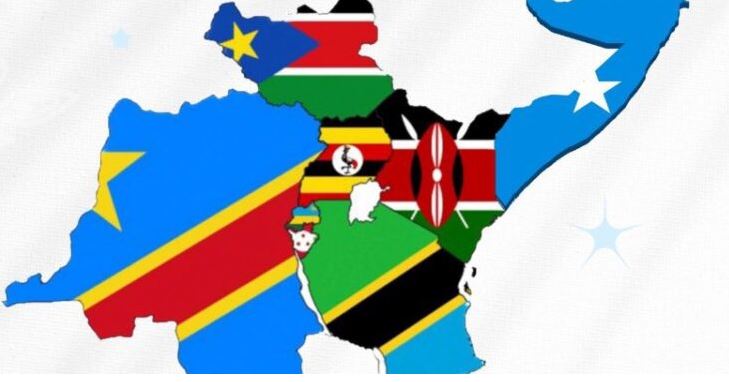
The much talked about East African Community Common currency has been pushed to 2031, as member states continue to frustrate the implementation of the Common Market through non-tariff barriers.
The EAC Secretary-General, Veronica Mueni Nduva announced on August 22 in Arusha that the Monetary Union was expected to be established in 2024 as per the Monetary Union Roadmap. However, it could not be realised and the timeline has been revised to 2031.
She said that some articles on the monetary union roadmap have been implemented, however, the eight EAC member states remain divided on several other aspects. This means a major delay in the EAC integration timetable that is already struggling with the implementation of Common Markets.
The touchy areas include; the development of the legal instruments for the establishment of institutions to support the Monetary Union—which she said are in various stages of the approval process or operationalisation.
However, she said that there are positive developments that central banks within the EAC have established the East African Payments System (EAPS), a multi-currency platform that enables settlements in the local currencies of the partner states that enables currency convertibility across the region.
However, there have been delays in obtaining a consensus on which country should host the East African Monetary Institute (Eami)—the precursor to the East African Central Bank.
“Partner States have signed and are implementing an MOU on Currency Convertibility and Repatriation. A legal instrument for the harmonization of excise taxes has been developed and is under consideration by the Sectoral Council on Finance and Economic Affairs. An EAC Avoidance of Double Taxation Agreement has been developed and is under consideration by the Council,” said Ms Nduva.
The eight EAC member states include; the Democratic Republic of the Congo(DRC); Somalia; Burundi, Kenya, Rwanda, South Sudan, Uganda and Tanzania.
Ms Nduva expressed concerns that member states have not managed on the criteria to effectively converge the four macroeconomic fundamentals.
These include a headline inflation rate of eight percent, a foreign exchange reserve cover equivalent to 4.5 months of imports, a ceiling on the overall fiscal deficit set at three percent of gross domestic product (GDP), and a limit on gross public debt capped at 50 percent of GDP for all partner states.
The stages towards a unified currency were outlined in the 2013 signing of the EAC Monetary Union Protocol. The original 2024 date may not be reached, nevertheless, because of delays and difficulties with building the required institutions, correcting member state differences, and synchronising economic policies. More progress will probably define a more reasonable date for the union’s founding.
The establishment of the Monetary Union of the East African Community (EAC) has been hampered by some issues. Among the principal challenges are: divergence of the economy among the participating states; the fiscal policies, public debt, inflation rates, and economic development of the EAC member states differ.
These differences have made it challenging to meet the necessary convergence criteria, which include budget deficits, inflation rates, and foreign exchange reserves. Governance and Politics Disparities: The political structures, governmental structures, and stability levels of the member nations vary.
In certain nations, political instability or problems with governance may impede the necessary harmonisation for a successful monetary union. Legal and Institutional Frameworks: It has taken longer than expected to establish the institutions needed to oversee the monetary union, such as a regional central bank and the legislative frameworks.
The EAC Executive Director, Adrian Njau said that EAC has given priority to policies on trade, investment, and industrialization, as some of the efforts to remove NTBs and enhance both intra-EAC and external trade and investment opportunities.
“The EABC believes that active participation of the private sector in the integration process would sustain the EAC as the fastest-growing economic bloc on the continent,” said Mr Njau.
While noting that EAC exports to the rest of the world rose to $26.9 billion in 2023, up from $25 billion in 2022, Mr Njau said that there is also a reciprocal projected growth of EAC’s economy to 5.1 percent, up from 4.9 percent in 2023.
Mr Njau said that exports to Africa were $9.7 billion in 2023, matching the total value of imports from Africa, which increased from $7.9 billion in 2022 to $9.7 billion.
Yet, the delays in the Monetary Union have also been caused by the absence of a powerful, centralised organisation to supervise the procedure. Member states are wary of giving up responsibility over fiscal and monetary policy to a supranational organisation due to concerns about sovereignty.
This hesitation is a result of worries about losing authority over national economic policies, which are vital for addressing issues unique to a certain nation. Public Debt Levels: Keeping fiscal restraint within the confines of a monetary union may be more difficult in some EAC nations due to their high public debt levels.
Elevated debt levels have the potential to cause imbalances that compromise the stability of a single currency, amidst delays in ratification and implementation of protocols.: Despite the EAC Monetary Union Protocol’s 2013 signing, member states have taken their time ratifying and putting the requisite reforms and agreements into effect. External Economic Shocks:
Attempts to align the economies of EAC member states were made more difficult by global economic conditions, including changes in commodity prices and the COVID-19 pandemic’s effects
The EAC integration has had a long and winding road. Established under British rule as the East African Federation involving Kenya, Uganda and Tanzania, it was formally formed in 1967 but collapsed in 1977 due to political differences between Mwalimu Julius Nyerere and Idi Amin of Uganda on the one hand, and between the capitalist policies of Kenya and Socialisms of Tanzania on the other.
It was revived in November 1999 by presidents Daniel arap Moi of Kenya, Ali Hassan Mwinyi of Tanzania and Yoweri Museveni of Uganda. It became operational in July 2000 when the three presidents signed the Treaty of the Establishment of EAC.
The EAC has four main pillars; the Customs Union which was implemented without any hitches. Then there is the Common Market which has been experiencing hiccups due to NTS, as countries change goalposts to safeguard sovereignty.
The current crunch of the Monetary Union Protocol provides for the attainment of a single currency for daily transactions within the Common Market, and which has now been pushed from 2024 to 2031.
The last bit is the Political Federation where EAC Partner States envisage coming together to form a super-state under a single political authority or government under one leader, with other partner states acting as constituent bodies. This is still a dream given the political ambitions of the leaders in the region who are determined to hold on to their fiefdom.
