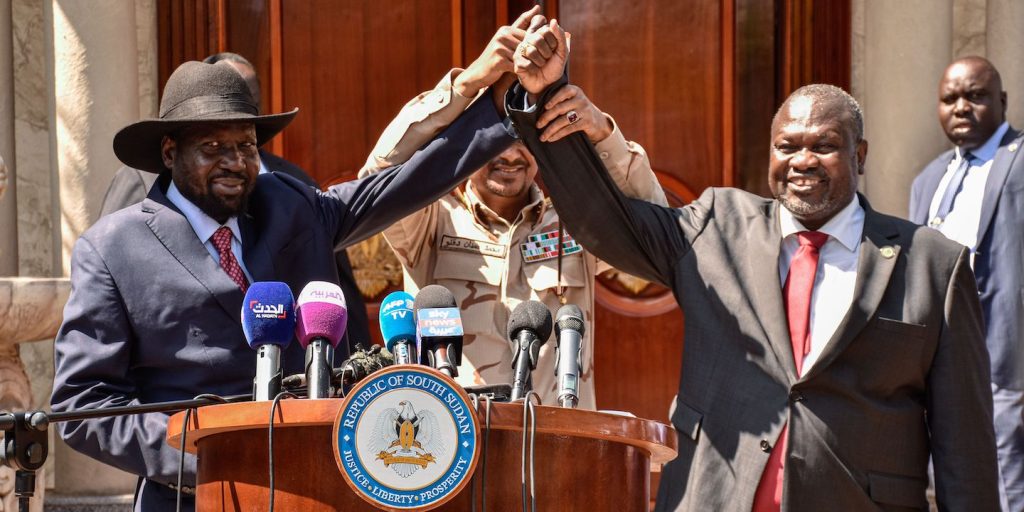
On February 22, 2024, South Sudan marked four years since the formation of the Transitional Government of National Unity (TGoNU).
Amidst challenges, these four years of inclusive transitional government represent a notable achievement, which if added to the Pre-Transitional Period beginning in September 2018 when the Peace Agreement was signed, marks the longest period of relative peace, inclusivity, and stability since independence in 2011.
These are hard-won gains to be consolidated and protected, especially given that the year 2024 in South Sudan is an election year, a critical requirement of the Agreement and one that marks its ultimate success if conducted by the requirements of the Agreement.
The slow pace of implementation of the critical tasks and the limited extent of election preparedness is giving serious cause for concern to the Reconstituted Joint Monitoring and Evaluation Commission (RJMEC) and the people of South Sudan.
The prospects of delivering the country to a democratic dispensation should motivate all stakeholders, given that much work needs to be done to create an enabling environment for the conduct of free, fair, and credible elections.’
These tasks are not insurmountable, and the parties to the peace agreement working collegially can still deliver credible, peaceful, free, and fair elections as envisaged in the Agreement at the end of the transitional period.
Back in 2020 when the Transitional Government of National Unity (TGoNU) was formed, the key stumbling block was the number of states and their boundaries.
Nonetheless, through commendable acts of leadership which included dialogue, compromise, and collegiality, this obstacle was successfully overcome and the parties settled on 10 states that existed before the outbreak of the civil war in 2013.
As the timelines for elections in December 2024 draw closer, it has to be clear that the legitimacy of the TGoNU expires one year from now, in February 2025.
This, therefore, calls for a sense of urgency, concurrent activities, and delivery at speed, to complete the critical tasks required for an enabling and conducive environment for credible democratic elections.
It is therefore imperative that the three crucial institutions, namely the National Constitutional Review Commission, the National Elections Commission, and the Political Parties Council, are fully resourced and operationalised to enable them to undertake their full mandate immediately.
Implementation of the Transitional Security Arrangements, especially the completion of Phase I and Phase II unification of forces, is moving very slowly and needs to be expedited.
The Necessary Unified Forces (NUF) are intended to provide elections-related security, but at present, the TGoNU has deployed only 4,000 personnel out of an intended total of 83,000.
Disarmament, Demobilisation, and Reintegration (DDR), for those who will not be eligible for unification and ex-combatants, is of great importance for the stabilisation of the country especially in the post-election period. Unfortunately, the DDR process lacks funds.
Security is a fundamental requirement, especially for a country going for elections in a post-conflict environment, and so it is a serious concern. Many parts of the country have experienced incidents of intercommunal violence so far this year.
The renewed peace process between the TGoNU and the hold-out groups, to be conducted with facilitation by Kenya, following the request by President Salva Kiir to President William Samoei Ruto is welcome. There is hope that this new initiative will take the process forward.
However, it is disheartening that the humanitarian situation continues to worsen, compounded by the influx of refugees and returnees fleeing the conflict in Sudan.
The scale of need in South Sudan is already high, service delivery is low, and the few resources available are very stretched. At the same time, voter registration is an essential factor for elections. A pressing but unanswered question is, how are South Sudanese people outside the country, or displaced internally, expected to participate in elections?
The four years of the TGoNU have witnessed some legal and institutional reforms, including in the areas of resource, economic, and financial management.
There is no doubt that more work remains to be done, but the legal and policy frameworks established by the TGoNU will continue to enhance transparency and accountability in economic and financial sectors even after elections.
The process of transitional justice is still pending. It involves the establishment of the Commission for Truth, Reconciliation and Healing and the Compensation and Reparation Authority, which is supposed to bring about national healing.
But most important is the enactment of a permanent constitution. The new constitution is expected to establish a new social contract between the people and their government.
The Parties need to honour this solemn promise, by expediting the constitution-making process, and by adequately facilitating the reconstituted National Constitutional Review Commission to enable it to deliver its mandate.
A new constitution will also give way forward in realizing the elusive 35% minimum threshold for women’s representation in all mechanisms of the agreement.
The author is the Interim Chairperson of the Reconstituted Joint Monitoring and Evaluation Commission (RJMEC)