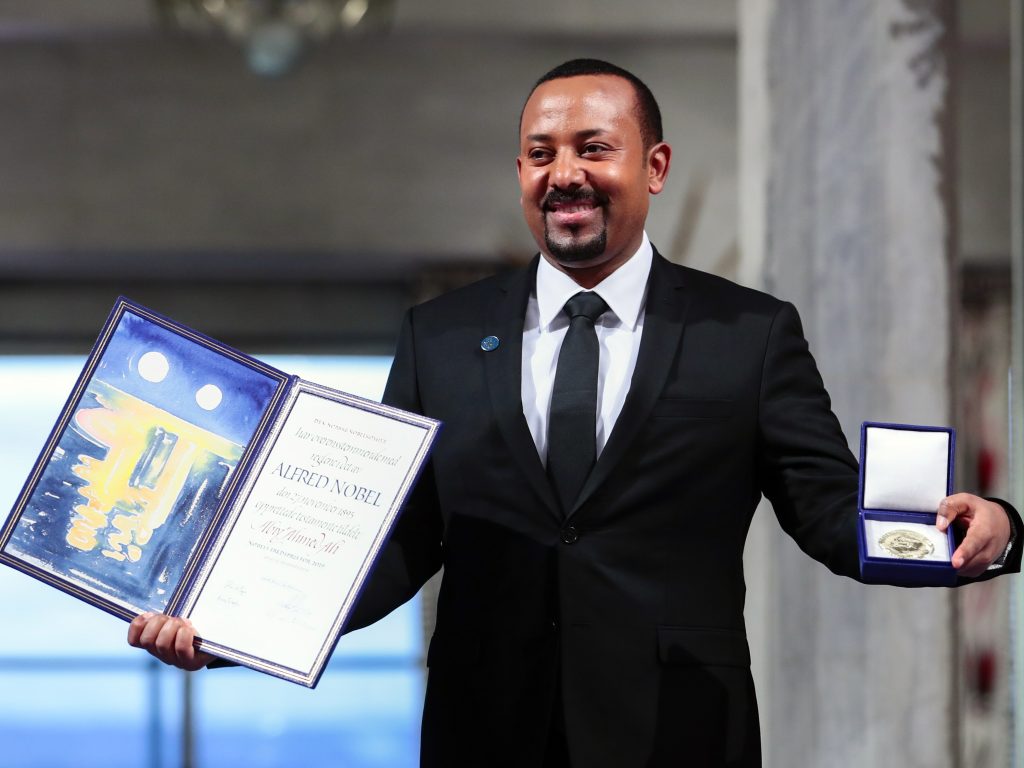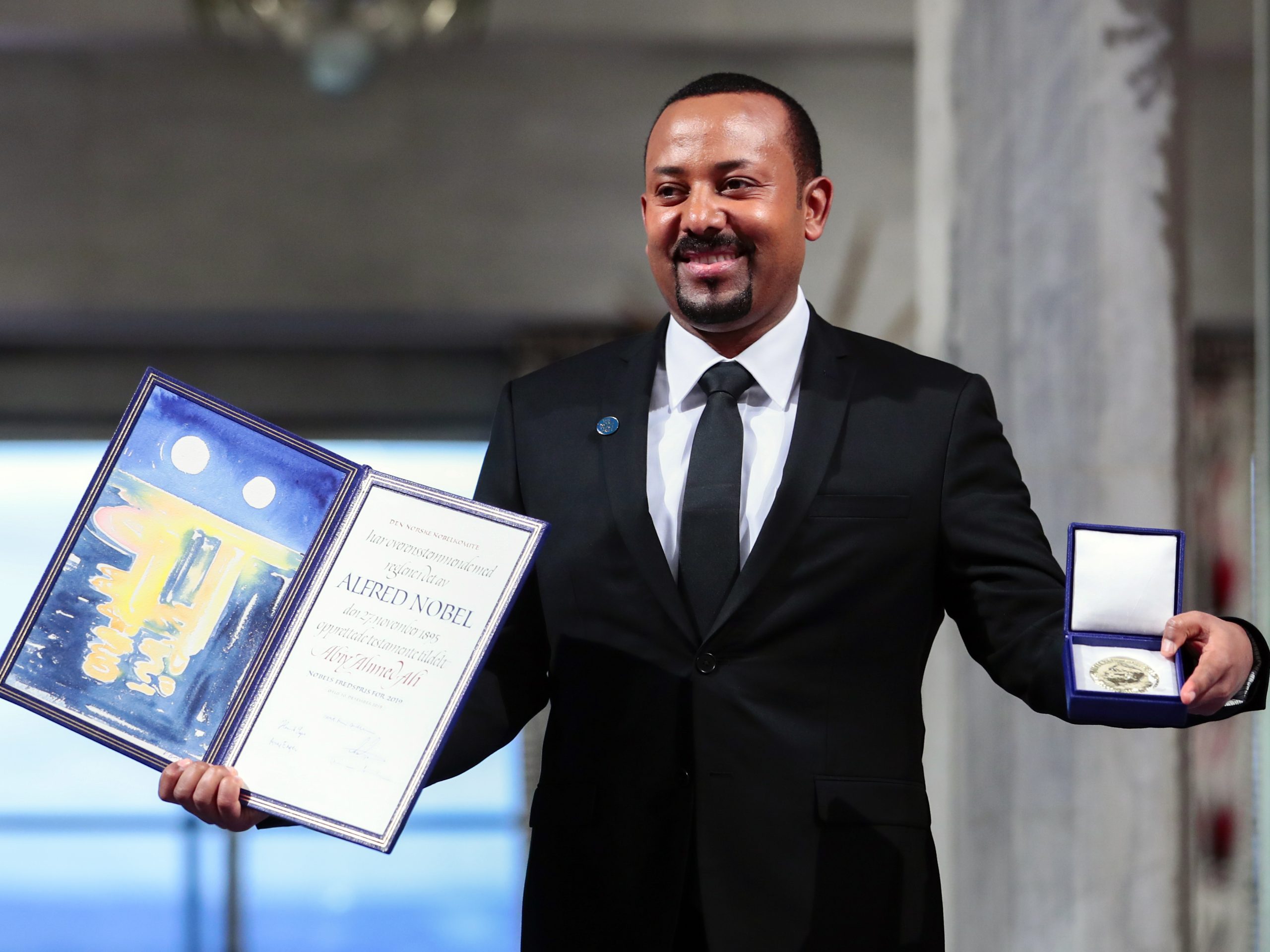
He burst on to the scene like a dynamite, acting with speed and alacrity that soon convinced many that he could be the antidote to Ethiopia, a country so devastated by decades of tyrannical rule. Abiy was taking over in 2018 from Hailemariam Desalegn, who had abundantly demonstrated his lack of depth, coupled with unwillingness to fix the mess wrought on Ethiopia by the diminutive but overbearing and lethal Meles Zenawi.
One of Abiy’s most radical decisions was to mend fences with Eritrean President Isaias Afeworki, following two decades of hostilities. The two neighbours reopened diplomatic channels in 2018, at a time the revolutionary Afeworki, who led his country to independence, was considered a pariah and with sanctions imposed on his economy and his key lieutenants accused of dictatorship, a charge he denies.
At home, Abiy extended an open arm to Ethiopia’s disparate political formations. He presided over a countrywide party merger that birthed the Prosperity Party, in a bid to distance Ethiopia from ethnic federalism. For over two decades, following the 1991 overthrow of Mengistu Haile Mariam, the vast country’s politics and economy were dominated by the Ethiopian People’s Revolutionary Democratic Front (EPRDF), a coalition dominated by the minority Amhara and Tigray. Abiy came in with the advantage of having his roots among the majority Oromo, who were disenchanted with years of marginalisation.
Further, Abiy won accolades when he filled half of his new cabinet with women, setting the pace for Parliament to consolidate the gender parity move by appointing Ethiopia’s first female president. Sahle-Work Zewde, 68, a seasoned diplomat who had held positions in the United Nations and worked in peacekeeping operations in Africa, accepted the position following the unprecedented appointments of women to lead the Defence ministry and the secret intelligence agency, a long-feared state organ that got a face-lift.
On the economic front, Abiy also set out to open Ethiopia to more investors, a most significant result of which was the embracing of the Kenya-based telco Safaricom. At a licence fee of US$850 million, Safaricom Telecommunications Ethiopia P.L.C. (STE), became the single largest Foreign Direct Investment into Ethiopia
But it was the rapprochement with Eritrea that earned Abiy the Nobel Peace Prize in 2019. Ethiopia and Eritrea even went ahead to contemplate a new partnership with Somalia, colloquially referred to as the Cushitic Alliance. However, the alliance hit headwinds following the end of the tenure of Mohamed Farmajo in Somalia.
Today, however, a lot seems to have failed in Abiy’s grand plan for a new Ethiopia. While emerging from a two-year egregious war with the Tigrayan People’s Liberation Front (TPLF), his federal government is contending with another conflict with the Amhara Fano rebels, who had joined forces in the war against TPLF. Ethiopia’s largest Oromo region remains as restive as ever, while the Prime Minister’s controversial sea access deal with the non-recognised Somaliland has put him on a collision course with Somalia and her allies. The regional Intergovernmental Authority on Drought (Igad), too, has been rattled by the move.
Abiy is facing accusations of presiding over an increasingly repressive regime, with little regard for civil liberties. Amnesty International has even alluded to last month’s extra-judicial killing of civilians by the Ethiopian National Defence Forces (ENDF) to amounting to war crimes. In a report last month, Amnesty stated that the extra-judicial killings in the Amhara capital Bahir Dar in August and October 2023 “could amount to war crimes”. It said the widespread impunity in the country encouraged perpetrators of grave atrocities, and urged the government to urgently open an independent investigation into the human rights violations in Bahir Dar and other areas of the region.
The Committee to Protect Journalists (CPJ) too has recently been on Abiy’s case, following the detention by Ethiopian security forces of French journalist Antoine Galindo in Addis Ababa, the first since 2011. In a statement, CPJ said the journalist with French website African Intelligence, was detained alongside a political officer with the Ethiopian opposition Oromo Liberation Front (OLF), Bate Urgessa, while conducting an interview. Though Galindo has since been released, his incarceration has left a blot on the Abiy regime.
Abiy is equally accused of failure to rein in the rebel groups, thus exposing innocent civilians to their atrocities. Last month, for instance, the Ethiopian Orthodox Church said the Oromo Liberation Army (OLA) killed four of its fathers (clergy) at Ziquala Debre Kewakibt Abune Gebre Menfes Kidus Monastery in East Shewa, Oromia region. The church appealed to the Federal and the Oromia regional governments to protect the monastery.
To his credit, Abiy is engaged in several peace initiatives at home, but so far, he has little to show for the efforts. He also seems to have had a rethink of his MoU with Somaliland, and embarked on a regional diplomatic offensive, having snubbed an Igad summit aimed at discussing the controversy. How Abiy wriggles out of the labyrinth he finds himself in today, may not be predicted with precision, but with the knowledge of hindsight, one is inclined to think that the Nobel Peace panel might have acted too soon, bestowing upon him the coveted award.