While there is a scramble to belong to the East African Community, Somalia the latest entrant has brought a new dimension—business.
Somalia is known for the instability brought about by al-Shabaab but little do the rest of the region know that the Somalia resources are developing the region curtesy of the conflict.
Burundi and Rwanda were admitted to EAC in 2007 to learn from good practices and stop their wars. The same as Democratic Republic of Congo (DRC) that was admitted in April 2022, But Somalia comes with a minus touch.
A look at Nairobi’s Eastleigh estate can tell what Somalia portends for EAC. A once sleepy neighbourhood has been turned into a must go shopping area for Nairobi residents courtesy of the Somali entrepreneurship.
Kenya has a big population of citizen Somalis, but the rest of EAC countries have been reluctant to accept them. Uganda has a sizeable number of Somalis.
Tanzania has been very resistant of Somalis, just like Rwanda and Burundi. But now that Somali is member of EAC, things are likely to change.
Somalia president Hassan Sheikh Mohamud said joining the regional trade bloc was a “beacon of hope” for Somalia. “Somalia belongs to East Africa.
“We are people who share one destiny,” President Mohamud told the press after accession, adding that Somalia is blessed with untapped resources of oil and gas plus vast arable lands.
Somalia is coming with a 3,000km coastline—the longest in Africa—that brings direct access to the Arabian Peninsula. This region is a key entry point of trade between East Africa and the Middle East.
Somalia’s membership to the EAC has also opened the doors for neighbouring Ethiopia and Djibouti to join the EAC if they so wish.
Somalia’s inclusion in the EAC could provide new market opportunities for businesses within the region, as well as facilitate trade and investment flows between Somalia and other member states.
Peter Mathuki, the former EAC secretary general said that Somalia with the longest national coastline of over 3,000kms in Africa, linking Africa to the Arab Peninsula, which the region can tap into to exploit Somalia’s blue economic resources and increase intra-regional trade and improve the lives of East Africans.
The reasons given for admitting these four members—Rwanda, Burundi, DRC and Somalia—was that they would benefit from common good practices and find a shoulder to lean on in case of trouble. But South Sudan, DRC and Burundi are yet to transform significantly despite EAC membership.
The conditions for EAC membership include; adherence to universally acceptable principles of good governance, democracy, the rule of law, observance of human rights and social justice; potential contribution to the strengthening of integration within the East African region; geographical proximity to and inter-dependence between it and the Partner States; establishment and maintenance of a market driven economy; and social and economic policies being compatible with those of the Community.
But what does Somalia citizens benefit from EAC? Citizens of Somalia are going to benefit from visa-free movement within the EAC member states, enhanced trade within the region, and common approach by EAC to Somalia’s security challenges.
It will now be the duty of EAC partner states to ensure that Somalia is pacified without relying on the United Nations. Somalia citizens can now work and open more businesses in the region, especially in Tanzania which has been very strict on investments by Somalis.
Somalia could benefit from the sharing of knowledge and best practices in various fields, including technology, agriculture, and healthcare, among others.
Membership in the EAC may foster social and cultural integration, promoting people-to-people connections and understanding among member states.
Somalia has a predominantly informal economy, with various sectors such as agriculture, livestock, telecommunications, and remittances playing significant roles.
Historically, Somalia’s economy has been heavily reliant on agriculture, particularly livestock, which accounts for a substantial portion of the country’s GDP and employment. Additionally, remittances from Somalis living abroad have been a crucial source of income, providing significant support to many families.
From 2012 when President Mohamud applied for the then five-member East African Community (EAC), it was seen as a long shot. Indeed, analyst laughed off the application saying that Somalia did not stand a chance given the many challenges the country was facing.
In 2016, the EAC that was considering the two applications of Somalia and South Sudan accepted the latter but rejected Mogadishu’s application on grounds of serious insecurity, political instability and lack of democratic institution.
Somalia applied again in 2019 under President Mohamed Abdullahi Mohamed “Farmajo”. This was due to the fact that South Sudan was admitted in 2016 without meeting all the preconditions.
But it is the admission of the Democratic Republic of Congo (DRC)—that is whacked by conflict—that gave Somalia the courage that the country stands a chance.
In June, the East African Community Heads of State Summit held in Bujumbura, Burundi adopted the Report of the Verification of the application of Somalia. The report was a product of the verification mission launched in January 2023 to evaluate Somalia’s preparedness for Community membership.
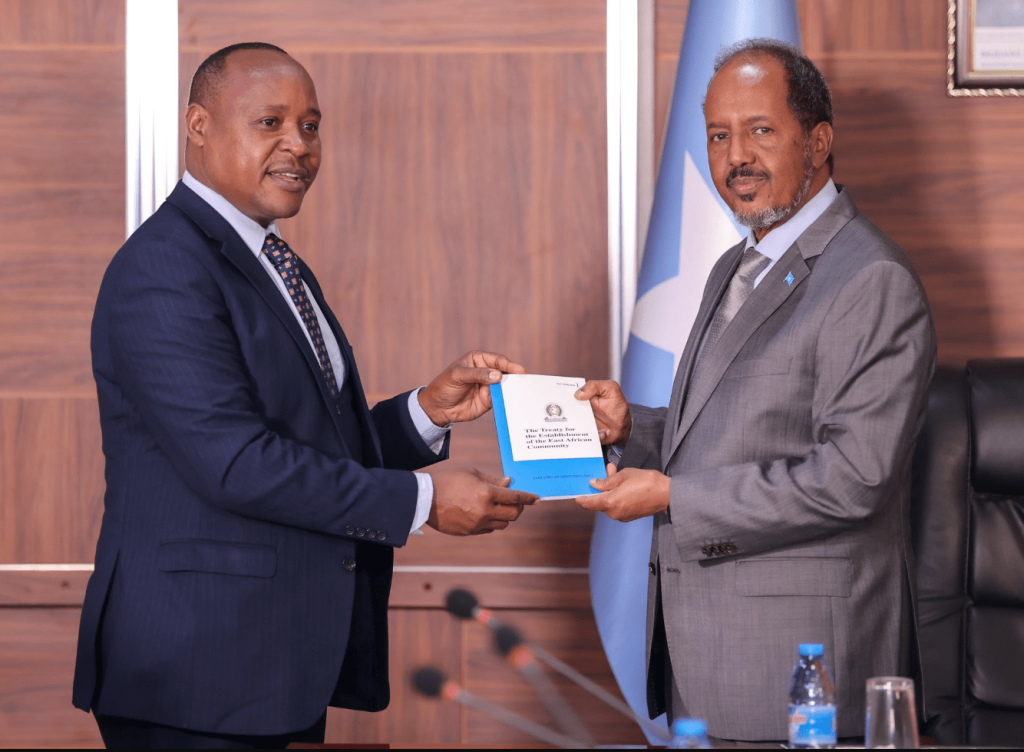
The verification team, which was made up of experts from the EAC Partner States, set out to determine how closely the nation adhered to the requirements outlined in the EAC Treaty for foreign admission. So, when the EAC heads of state met in Arusha, Tanzania on November 24 to consider Somalia’s accession, it was a forgone conclusion that Somalia would be the 8th member of the regional trade bloc, binging together a market for over 300 million.