

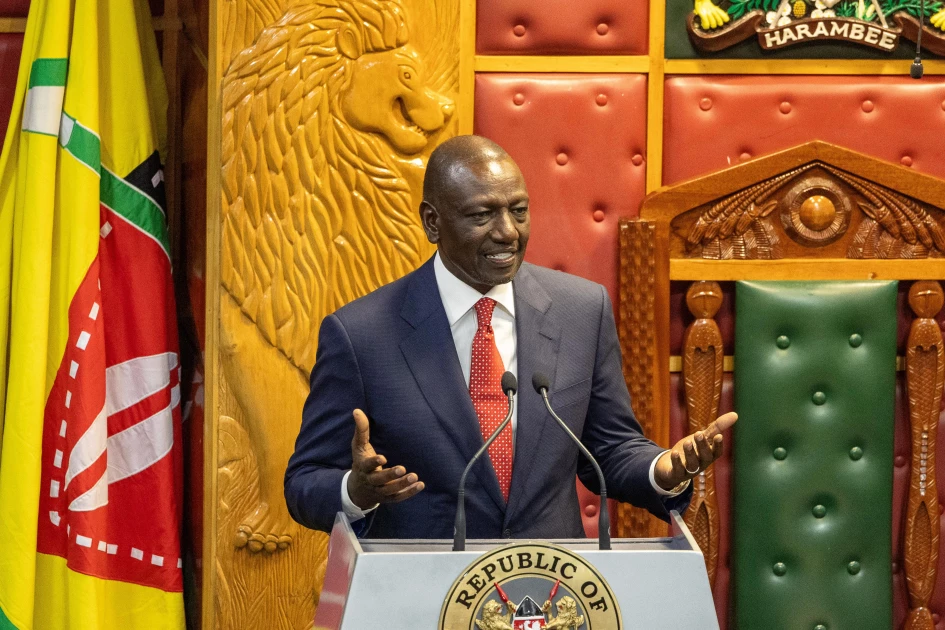
The government of William Ruto continues to abet corruption and the incidences are likely to surpass those of his predecessor, Uhuru Kenyatta.
The William Ruto era is focused on political survival, using a system of reward and patronage – built by former presidents – that depends on corruption and impunity.
This is according to the latest report by the Africa Centre for Open Governance (AfriCOG) that was released last week. Entitled State Capture: Inside Kenya’s Inability to Fight Corruption, the report traces the unfolding continuities and proliferation of corruption in Kenya under the Ruto government in the last two years and the last days of former president Kenyatta.
“The politics of patronage continues apace, as the President seeks to consolidate his support base, rewarding his supporters and inviting his erstwhile opponents into government. Corruption continues to deepen, scandals multiply, profligate wastage continues, institutional decline persists, and checks and balances are eroded,” said Gladwell Otieno, the Executive Director of AfriCOG.
The report shows how the main pool of resources available now to achieve reward and patronage is primarily through public budgets, dubious contracts, appointments to office, and facilitating a profligate and wasteful system to benefit of a few.
By the end of 2024, Ruto had been forced to cancel two flagship deals with the Adani Group, involving Kenya’s national airport and electricity grid, after Indian billionaire, Gautam Adani, was indicted for fraud in New York.
“The fate of the deals, which had long been unpopular and highly contentious in Kenya, symbolised the approach of a president who seemed to be far more sensitive to his international constituency than to the one at home,” the report says.
The report says that the scale and impunity of the perpetrators lead to the conclusion that corruption is effectively permitted and protected in spite of laws to the contrary.
With an annual budget of about $26 million, the Ethics and Anti-Corruption Commission (EACC) investigates corruption and promotes ethics and integrity from 12 regional offices; but there are doubts about its effectiveness and the quality of its investigations.
A study of five years of reports by the Auditor General between 2015 and 2020 recorded that only 13 percent of government revenue was properly accounted for and that 20 percent of government expenditure is stolen each year.
Yet convictions for corruption are the exception, not the rule. After being convicted of corruption, one need not serve a sentence. In Kenya, bail pending appeal is frequently granted in corruption cases where the convict is politically prominent, and justice is speedier than for the average person.
John Waluke, MP, freed on bail three months after being convicted and sentenced to 67 years for a multi-million-dollar fraud against the National Cereals Board, had his second appeal heard in October 2024. His conviction and sentence were quashed by the Court of Appeal.
Among the reported grounds for his release, the Appeals Court dwelt heavily on the fact that keeping the MP behind bars would trigger a by-election for his parliamentary seat virtue of Article of the Constitution which provides that the office of an MP becomes vacant if the member misses eight consecutive sittings of the House
Socially connected corruption convicts may also benefit from Presidential Pardons. In July 2023, Ruto used presidential clemency to release Dr Davey Koech, who had been convicted in 2021 and sentenced to six years in jail for corruption in his management of the Kenya Medical Research Institute.
“Signals like these in Ruto’s first two years of office make it hard to believe there will be any real change in tackling corruption during his presidency.” Says the report.
Impunity is demonstrably reducing public trust in official anti-corruption institutions. Over the past five years, the number of reports received and processed by the EACC declined by 43 percent from 9,308 reports in 2018 to 5,252 per annum in 2023.
During 2023, only 97 investigations on corruption and economic crimes were completed and forwarded to the Director of Public Prosecutions (DPP). Of this number 74 were recommended for prosecution. A further 61 investigations into ethical violations were completed, but what action resulted is not stated in the EACC Annual Report
In 2023 it ranked 127th out of 180 evaluated countries on Transparency International’s Corruption Perception Index. Kenya’s index score was 31 points, a slight decrease from 2022, but substantially below the flawed democratic countries’ average of 48 points.
“A very small proportion of such corruption reports result in investigation. By a process of bureaucratic elimination only 1,968 reports ended up being recommended for investigation; and of these only 512 cases were under investigation at the end of 2023,” said the report.
Early in President Ruto’s administration, the Office of the Director of Public Prosecutions (DPP) began withdrawing court cases against persons it had charged with various corruption offences and economic crimes.
The DPP explained his decision as being based purely on the materiality of the evidence, and not on the social, economic or political connections of the accused. He claimed to have withdrawn over 25,000 cases
But President Ruto’s critics point to the coincidence between the withdrawal of charges and subsequent appointments to high public office. Defenders of these prosecution withdrawals maintain that many cases were instigated in the last years of President Kenyatta’s administration against supporters of then-Deputy President William Ruto.
The most high-profile politician whose cases were dropped by the DPP is former deputy President Rigathi Gachagua: Gachagua and his associated companies were charged in July 2021 with six counts of economic crimes and laundering of proceeds of crime between January 2015 and June 2019. The Serious Crimes Unit of the DCI compiled a dossier against Gachagua concluding he had improperly obtained over $55 million through supply contracts with five county governments.
After Gachagua became deputy president, the DPP withdrew all charges in early November 2022, alleging incomplete investigations warranted the withdrawal of the charges under section 87A of the criminal procedure code.
On November 21, 2024, Ruto was forced to drop one of his most unpopular flagship deals when it emerged that a New York court had indicted Indian billionaire, Gautam Adani, for a massive international fraud and bribery scheme.
The Adani Group lease of Kenya’s international airport in the capital, Nairobi, provoked enormous public controversy. According to the March 2024 proposal, Adani Group would lease Kenya’s JKIA for 30 years while investing $1.85 billion. This provoked public outrage that Ruto was ‘selling the airport’.
US Attorney Breon Peace said in a statement announcing the charges against Gautam Adani. “My office is committed to rooting out corruption in the international marketplace and protecting investors from those who seek to enrich themselves at the expense of the integrity of our financial markets.” So the Kenyan public had been right, but it took a New York court case to stop President Ruto.
A second contentious, single-sourced Adani Group contract had been signed in October 2024, just one month before the momentous impact of the Adani corruption charges in New York, US. The contract signed with Kenya Electricity Transmission Company, KETRACO, provided that the national electric power grid transmission network would hire Adani. President Ruto said in parliament that the KETRACO contract has also been cancelled.
President Ruto’s first cabinet meeting revived a moribund trading parastatal, the Kenya National Trading Corporation (KNTC), when it approved the importation of 125,000 tons of tax-free cooking oil, which select firms were gifted.
The three companies contracted to import the goods were linked to close supporters of President Ruto. In October 2024, the Senate Committee on Trade was informed by the KNTC that it issued Letters of Credit to a few politically connected firms that imported 2,517,788 litre cans of edible cooking oil.
The Auditor General reported that unscrupulous traders infiltrated the KNTC programme and were able to import their consignments duty-free. In June 2023, according to Daily Nation estimates, the importers’ haul amounted to US$ 300 million.
A Senate Committee heard from the Acting CEO of the KNTC that its banker, Kenya Commercial Bank, ultimately paid Multi Commerce FZC $69,894,300, Charma Holdings $ 14.976.720, and Shehena Commodity $ 402,600 – for the edible cooking oil sitting unsold in warehouses or at the port not cleared by Customs.
The failure to get the imported oil to market defeated the purpose of the programme and, according to the Daily Nation, cost taxpayers over $50 million.
The report says that institutions established by the Constitution to enforce laws, fight corruption and monitor public finances are weak and susceptible to political influence.
Members of President Ruto’s cabinet have been accused of ineptitude and graft, but parliament has not used its constitutional powers to hold errant cabinet secretaries to account.
There is instead indication that Ruto’s hold over Parliament means it is serving less and less as a check on the Executive, and the absence of a strong or motivated opposition is likely to facilitate a surge in corruption.
A Senior Counsel of the Kenyan Bar alleged that former Agriculture Cabinet Secretary, Franklin Linturi, had engaged in a cover-up, and documented the attempt to coerce a fertilizer manufacturer to falsely take responsibility for fertiliser consignments that had been delivered to farmers through the NCPB
In May, following public pressure, an impeachment motion was passed in the National Assembly against the Cabinet Secretary for Agriculture. Ten days later, however, the Cabinet Secretary was cleared by an 11-member Select Committee of the National Assembly, which had been organised to take evidence and report to the whole House. The Committee had refused to call two key witnesses against the Minister, leading to public accusations that it was compromised.
The National Assembly has never exercised its vetting power of Executive appointments to block a cabinet appointment. All Ruto’s nominees to cabinet were approved after the National Assembly perfunctorily dismissed substantive petitions by the public and civil society documenting reasons for ineligibility under Chapter Six of the Constitution that deals with integrity.
It says the National Assembly has failed to use “the power of the purse” to limit extra-budgetary spending; a phenomenon long identified as a corruption risk.
The report also traces the last days of the Kenyatta presidency. The last months of Kenyatta’s administration were characterised by arbitrary unauthorised expenditures on a large scale, even though Article 223 of the Constitution authorises the Treasury to undertake extra-budgetary spending and seek parliamentary approval later.
In the 2022/23 financial year, the Controller of Budget authorised withdrawals of $63 million, a quarter of which became controversial when Controller of Budget Margaret Nyakang’o alleged before a committee of the National Assembly that she had been intimidated.
Nyakang’o said she was given a 26-minute ultimatum by the Cabinet Secretary for Finance to authorise payments amounting to $168 million four days before the general election, even though public finance management procedures had not been followed.
Last-ditch payments abusing the extra-budgetary Supplementary Appropriation device of the Constitution, include: – $46 million on an unauthorized deal to buy back 60 percent of the issued shares in Telkom Kenya, a failing communications company sold to UK-based private equity firm Helios Investment
In March 2023, the Controller of Budget, Margaret Nyakang’o, told a Parliamentary Committee that she was coerced by the then Cabinet Secretary for Finance, in the name of the president, to sign off on $171 million unapproved expenditure four days before the 2022 election.
This serious allegation has not been investigated by the Ethics and Anticorruption Commission and is not in the Controller of Budget’s Annual Report.
It is also omitted from the final report of the Budget and Appropriations Committee of the National Assembly. The only apparent consequence was the Director of Public Prosecution authorizing the Director of Criminal Investigations to arrest Margaret Nyakang’o in December 2023 to charge her with fraud offences. These arose from complaints made against her and other officials in 2016 by a Savings Society member.
The report says uncontrolled extra-budgetary spending is a serious national problem, which went ahead on a large scale just before the 2022 election.
A significant proportion of the spending was concentrated around the Presidency, Treasury, Interior Ministry and populist subsidy schemes run through the food and energy sector ministries. The table below extracted from the Controller of Budget’s (CoB) Budget Implementation Review Report for FY 2022-2023 depicts the scale of unapproved spending.
In the run-up to the 2022 election, three road contractors were paid upfront a total of $72 million for what is described as ‘flagship infrastructure projects’. When the CoB asked why the payments were being made ahead of contract, she was subjected to intimidating messages from the Finance Cabinet Secretary. She eventually signed off on the road contractors’ money.
Extra-budgetary spending was also used by President Kenyatta to assist his party’s candidate ahead of the elections. He directed$268 million be spent on short-term subsidies to artificially reduce consumer prices of petroleum, maize and fertilizer products.
There is also the challenge of budgeted corruption and the public payroll. The latest Budget Implementation Review by the CoB raised another risk area. The CoB reported a massive $475 million variance between the payroll records of ministries, departments and agencies, and the overall IFMIS system run by the National Treasury.
The scale of variance in 2022-2023 was alarming -$475 million is equivalent to half the budget of the Ministry of Health. The reason for the variance is a practice that has developed across the government of making payments “outside the prescribed payroll management system”. Among these are payments for casual employees, salary advances to staff, and other staff allowances
In January 2024, the CoB alert was vindicated by the Public Service Commission in a report which documented nearly 20,000 ghost workers in government. The PSC reported an excess of 19,467 members of staff recorded in the staff registers against those reported in the approved filled vacancies.
