

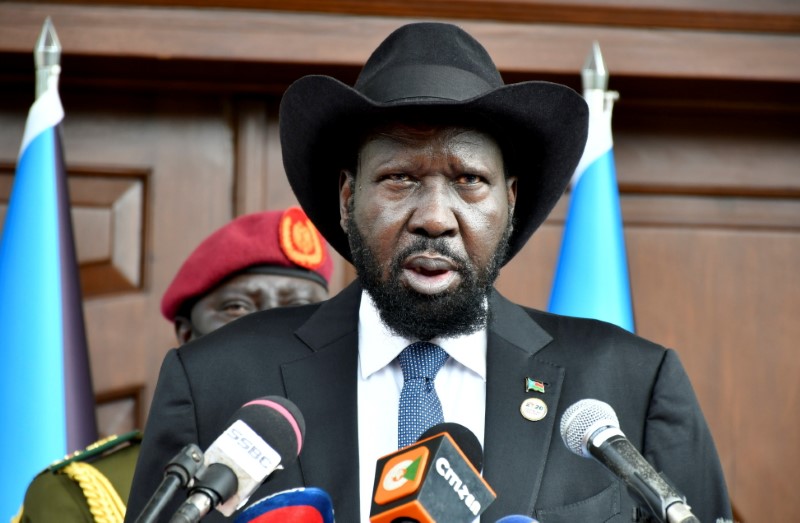
Did President Salva Kiir of South Sudan deserve to take over the chairmanship of the East African Community?
That is the question that has been taking the rounds given that since its accession in 2016 without meeting all the preconditions. South Sudan has been lagging in annual contributions and only cleared its outstanding debt of $15 million after the summit waived over half of the $36 million arrears.
The recent ascension of the Republic of South Sudan’s President Salva Kiir to the chairmanship of the East African Community (EAC) is a strong positive signal of progress and a diplomatic leap forward for South Sudan and the region. This is particularly resonant, given our history of overcoming strife since the formation of South Sudan in 2011.
Upon joining the EAC in April 2016, South Sudan under President Kiir’s administration, has seen commendable efforts in rebuilding and strengthening its national institutions.
Despite the challenges, the President’s commitment to the Revitalized Agreement on the Resolution of Conflict in South Sudan (R-ARCSS) signed in 2018 demonstrated his strong will towards peace and stability. This peace agreement, which ended years of civil war, has laid the groundwork for national healing and the country’s future development.
President Kiir‘s administration has also initiated several infrastructure projects, including the construction of roads linking South Sudan to its neighbours Uganda and Kenya, which is crucial for trade and regional integration. These efforts will not only open up new avenues for economic activity within South Sudan but will also enhance our country’s connectivity within the EAC, fostering greater economic synergy.
President Kiir’s government has been working towards increasing South Sudan’s agricultural potential. South Sudan has significant agricultural potential due to its abundant land and water resources.
South Sudan is endowed with vast expanses of arable land, much of which remains untapped. The country’s fertile soils have the potential to support a variety of crops.
Others are water resources of the Nile River and its tributaries; diverse agroecological zones, ranging from savannahs to tropical forests; and potential for livestock farming, including cattle, goats, and sheep.
Moreover, under President Kiir’s directive, South Sudan’s recent efforts to clear its arrears with the EAC demonstrate a commitment to fulfilling its financial obligations to the community. This move indicates South Sudan’s dedication to the EAC’s principles and its desire to be a reliable and contributing member of the bloc.
President Kiir’s leadership in these areas should be seen as foundational to the next stage of South Sudan’s contribution to the EAC. His tenure as the Chairperson of the EAC presents a strategic opportunity to further these efforts. It is a chance to elevate South Sudan from a nation rebuilding from conflict to one that is a cornerstone of regional stability and development.
The chairmanship also provides a platform for President Kiir to advocate for issues close to South Sudan’s experiences, such as conflict resolution, humanitarian assistance, and sustainable development, and to push for policies that benefit all member states of the EAC.
Criticism and scrutiny come hand-in-hand with high office, and President Kiir’s tenure must be assessed against his actions and policies that further the EAC’s objectives. As he assumes this regional role, the focus should be on how South Sudan, under his leadership, can work with other member states to achieve the community’s vision of a prosperous, competitive, secure, stable, and politically united East Africa.
In diplomacy, when neighbouring countries work together to enhance national development and mutual progress, it is a testament to a shared vision and political maturity. This unity of purpose is not only a marker of diplomatic evolution but also a foundational step toward achieving lasting economic prosperity and regional security.
In the EAC, South Sudan, under President Kiir’s leadership, has been a proactive participant in discussions around the Customs Union and the Common Market, which are central to the bloc’s economic integration. South Sudan’s unique position and experience with internal conflict have provided invaluable insights into the EAC’s security and governance dialogues, shaping policies to prevent conflicts within the region.
President Kiir’s engagement in the EAC’s infrastructure and health sectors has also been significant. South Sudan has played a part in regional efforts to combat transboundary diseases and improve healthcare, as exemplified by its cooperation in the EAC’s joint COVID-19 management strategies. This cooperation has been critical during the pandemic and exemplifies the kind of regional solidarity that President Kiir champions.
In the meantime, despite receiving a heroic reception after being elected the chair of EAC, President Kiir is facing rising inter-communal fighting due to lackluster implementation of the 2018 peace agreement, cattle rustling due to economic difficulties, and revenge killing arising from the now 10-year war.
New fighting has broken out in Guit, East of Bentiu. There have been constant clashes in Abyei, the disputed region between Sudan and South Sudan is bearing the brunt of the conflict in the north, with the flow of the displaced heightening the existing tensions in the region.
Abyei, which lies between Sudan’s states of South Kordofan and Warrap, and Northern Bahr-el-Ghazal states in South Sudan, has been experiencing tensions for 18 years, having failed to conduct a referendum to determine to which country they belong.
The United Nations Mission in South Sudan (UNMISS) recorded 35 injuries and 117 civilian deaths between April and June as a result of inter-communal conflicts in Greater Tonj, attacks on communities in Tonj North County by armed Nuer and Dinka youth, and renewed intercommunal fighting between the Dinka Twic Mayardit and Dinka Ngok communities in the Abyei Administrative Area.
