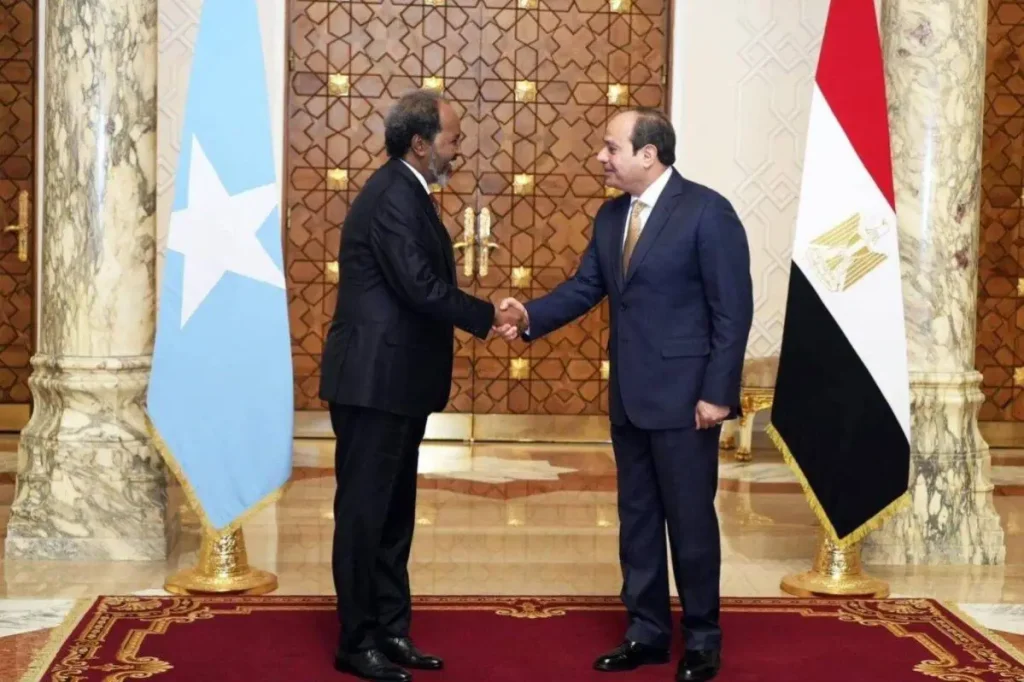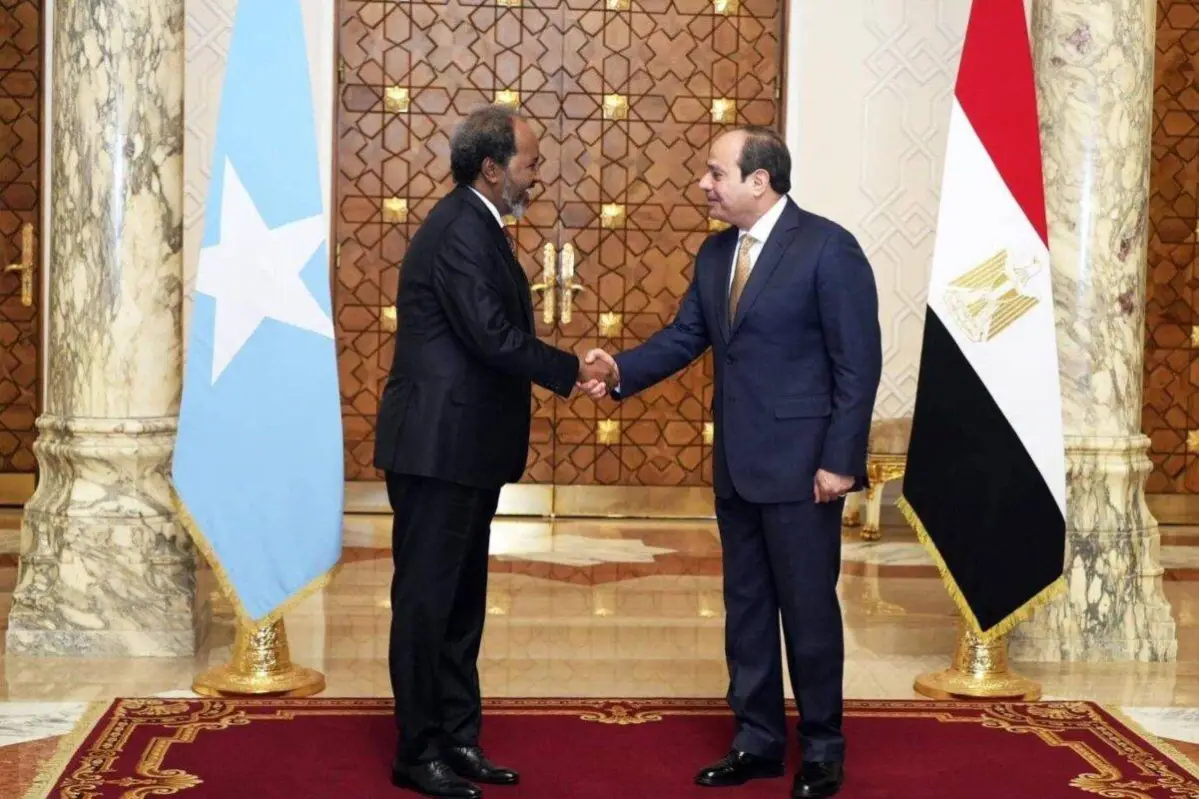
The tension between Ethiopia and Somalia that started in January when Addis Ababa signed an agreement with the breakaway Somaliland has escalated after Egypt delivered military equipment to Mogadishu.
Two Egyptian military aircraft landed in Mogadishu delivering military equipment and officers headed to the Hiiraan region. 10,000 Egyptian troops will be deployed across Somalia (South West, Hirshabelle, and Galmudug), with 5,000 joining the African Union Support and Stabilisation Mission in Somalia (AUSSOM) forces and 5,000 supporting the Federal Government independently.
Two C-130 military planes on Wednesday, August 28, delivered senior Egyptian army officers and heavy equipment at Adden Ade International Airport in Mogadishu to prepare to deploy 10,000 Egyptian troops in the war-torn country.
Given that Egypt had threatened to bomb the Grand Ethiopian Renaissance Dam (GERD) built on the Blue Nile that supplies 80 percent of water to Egypt, Addis Ababa is feeling threatened that enemy forces could be stationed Hiiraan region, which is within a sticking distance.
Ethiopia has said that it will not stand by when Egypt deploys troops in Mogadishu, claiming that doing so would jeopardise the peace and stability of the area. Ethiopia borders Somalia.
“Ethiopia cannot stand idle while other actors are taking measures to destabilise the region. Ethiopia is vigilantly monitoring regional developments that could threaten its national security,” said Ethiopia’s Foreign Ministry in a statement issued on Wednesday night.
The elaborate statement said that Ethiopia has worked tirelessly for the peace and security of Somalia and the region, for shared growth, and has nurtured the close bonds between the peoples of the region.
It continues that Ethiopia has also been engaged in facilitated discussions to resolve differences with the Government of Somalia. Tangible progress has been made in these talks. Instead of pursuing these efforts for peace, the Government of Somalia is colluding with external actors aiming to destabilise the region.
Already, tension between Somalia and Ethiopia has been ongoing since January when Ethiopian Prime Minister Abiy Ahmed and Somaliland’s leader Muse Bihi Abdi, signed a Memorandum of Understanding (MoU) that granted Ethiopia a 50-year lease on a naval base with access to Somaliland’s Berbera port for commercial marine operations.
Somalia had made it clear that Ethiopia would not be part of AUSSOM, which is supposed to take over from the African Union Transition Mission in Somalia (ATMIS) in January 2025.
On August 23, Somalia Prime Minister Hamza Abdi Barre in an address to the press in Mogadishu confirmed that Ethiopian forces would not be part of AUSSOM unless Addis Ababa withdraws from a controversial MoU with the self-governing Somaliland, which Somalia considers as an integral part of its territory.
Ethiopia has refused to withdraw the MoU because as a landlocked country, the deal with Somaliland would give it the long-desired access to the sea after Eritrea broke away in 1993 and took the ports of Asseb and Massawa with them.
The Egyptian action has raised a flurry of comments on the X space (formerly Twitter) as Somalis voice their different opinions. Most of the Somalis who expressed their views on X are opposed to the Egypt-Somalia military deal, while few others are supportive. Abdishakur Maalim, one of those who expressed their views said that Somalia is like a girl courting rival boyfriends to score points, why can’t it develop and equip its own military personnel?
Another contributor said that it is a horrible move from the Somalians because it completely dismantles the little sovereign power Mogadishu has. It’s a green light for Ethiopia and Kenya to permanently claim territory.
Anterneh Nima said Egypt is exerting significant effort to influence or control Somalia and its resources, allegedly due to direct actions by the Egypt president. However, the Somali government should engage in peaceful discussions with the Ethiopian government.
Another contributor said “This is a very sad day for our country. We got too scared of a fake MOU and invited Turkey to our maritime sea and Egypt into our land! It is not in our interest and we cannot bear a geopolitical crisis in our land. The fake MOU would have gotten to nowhere”.
“Egypt didn’t want to help their own bothers Palestine and even closed their borders. They sided with Israel. Why the rush to help Somalia?” asked Omar Haji
Others such as Ahmed Kulle Adan are in support of Egyptian intervention arguing that Ethiopia only understands the use of force. If they illegally start the operation at any port in Somalia, then the government has the right to destroy using drones and fighter jets, he said.
Massawa Adulis believes Somalia has formed a strong alliance to make certain that its sovereignty and territorial integrity are respected.
The belligerent Ethiopian leadership was a blessing in disguise to Somalia that will strengthen the unity and sovereignty of the nation.
Farah Abdul said “If the failed State of Somalia foolishly allows Egyptian mercenaries to be deployed in their already war-torn country, Ethiopia may launch a preemptive attack to counter the obvious threat,”
But can the two countries go to war, or in other words, can Ethiopia attack Somalia? Analysts say that chances of war are remote, given that Ethiopia—the second most populous country after Nigeria with 120 million people—is a military superpower in the region with more than 130,000 soldiers compared to Somalia’s minute 20,000.
Secondly, both countries already face a great deal of instability domestically. Mogadishu is waging a long war with the armed group al-Shabab. Ethiopia is dealing with the aftermath of the Tigray War as well as a new conflict in the Amhara region.
The military buildup in Somalia appears to be in full swing, with Egyptian forces poised to take an active role along Somalia’s Hiiraan region, near the Ethiopian border.
Are there chances of another war between Ethiopia and Somalia, this time with Egypt aiding Mogadishu to serve their own interest over the GERD? In 1977, Somalia invaded Ogaden, a disputed border territory now in Ethiopia. Backed by the Soviet Union and Cuba, which were seeking a cross-continent socialist alliance, Ethiopia responded and eventually won the war. Ethiopia eventually won the war.
The decimation and defeat of the Somali army and the eventual rebellion that it prompted internally are linked to Somaliland breaking away from Somalia.
On August 1, the African Union Peace and Security Council established AUSSOM to replace the African Union Transition Mission in Somalia (ATMIS) by January 2025.
The new mission will prioritize ongoing peace-building measures and defer state-building efforts to international partners and the Somali Federal Government (SFG).
Egypt was the first to express interest in contributing troops to the AU mission for the first time, while four of the five current troop-contributing countries—including Ethiopia—have not confirmed their participation.
“If Ethiopia does not withdraw from its MoU agreement with Somaliland, its forces will not be part of the upcoming operation. If they remain, it will not be under the African Union mandate,” Mr Barre said during a town hall meeting in Mogadishu.
In response to Somali accusations, Ethiopia’s foreign ministry asserted its right to self-defence. “There is no power that can stop Ethiopia from taking necessary action without asking permission from anyone,” stated Nebiyu Tedla, Ethiopia’s foreign ministry spokesperson, during a news briefing.
“Ethiopia has been contributing troops to Somalia for over a decade. Ethiopia has security concerns arising from al-Shabaab; therefore, Ethiopia is following the issue closely,” said Mr Telda.