



Previous assertions that the Rapid Support Forces (RSF) is committing war crimes and crimes against humanity have been vindicated by their own video that shows gory details of human rights abuse.
The video shot by the many mercenaries that have joined RSF from the neighbouring countries and beyond, shows a group that is determined to destroy the country, the people and its infrastructure.
It shows violation of human rights—summary execution, ethnic cleansing, rape and slavery. Mostly affected are; Nyala, Zalingei and Al-Geneina in Darfur.
What started as a coup on April 15, 2023 where RSF attacked strategic targets in Khartoum seeking the President of the Sovereignty Council and other members, has now turned into a mindless destruction of infrastructure and indiscriminate killing of civilians.
The video—capturing scenes in Khartoum and Darfur—shows victims, both men and women, being whipped with their hands tied behind their backs.
Some of them are shot while lying on the ground, while some are put in shallow graves and shot. The video also shows a group of young men raping one woman.
The RSF fighters says in the video that they are fighting to restore democracy. But the video shows that the SRF is not targeting the army but civilians and infrastructure. –hospitals, banks, schools, universities and museums are looted and destroyed. The group attacked Morowe Airport as well as planes.
The RSF burned down the only money printing firm in Sudan—the Sudan Mint Company Ltd. Burnt down the Sufyan Oil Field and company buildings in eastern Darfur.
All foreign embassies in Khartoum and offices of None-Governmental Organisations have all been attacked. Churches, especially those of the Coptic Church have been attacked and some clerics killed.
In some sections of Khartoum under the control of RSF, civilians are trapped in their houses where humanitarian organisations are unable to reach them.
Sudan watchers say the reason why the RSF is attacking the people and infrastructure with reckless abandon, is because of the mercenaries that are determined to bring the country to its knees.
The mercenaries are coming from seven countries; Central African Republic (CAR), Chad, Niger, Mali, South Sudan, Libya and Ethiopia.
It is estimated that there are between 50,000 and 75,000 mercenaries in Sudan since the conflict started in April 15, 2023. Some come and loot especially gold and cross the borders back to their countries.
“There will be no armed forces in Sudan and there will be no country. We are ready for the destruction of Sudan,” one of the mercenaries is captured on video saying soon after the war begun.
On the first anniversary on April 15, the UN Secretary-General Antonio Guterres said that crimes against humanity are being committed in Sudan.
He said that indiscriminate attacks against civilians in Sudan could constitute war crimes and crimes against humanity “This is more than a conflict between two warring parties. It is a war being waged on the Sudanese people,” said Mr Guterres.
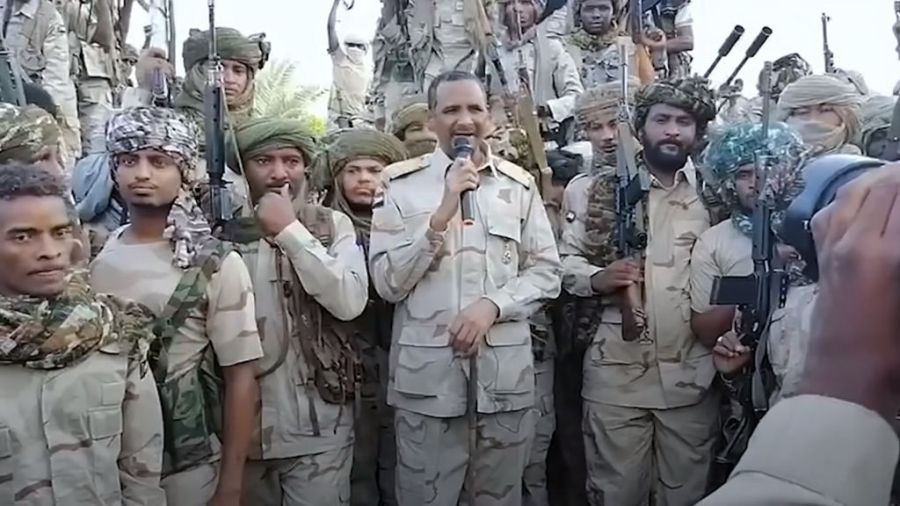
The video shows the RSF commander, Gen Mohamad Hamdan Dagalo mobilising troops in Khartoum in the early days of the conflict last year.
The RSF—created by the former president Omar al-Bashir from the former Janjaweed militia—refused to be incorporated into the Sudan Armed Forces (SAF) as part of the peace process, arguing it is a parallel army.
According to the first issue of Al-Hakika, an electronic magazine dedicated to documenting human rights violations in the Sudan war, the RSF has looted 1,273kg of gold, destroyed electronic metre factories in Khartoum and grabbed 7 million barrels of oil in areas under their control.
RSF controls most of Sudan’s western region Darfur and parts of the capital Khartoum. The RSF has recently took control of Wad Madani, one of Sudan’s major cities.
The attacks in Darfur are bordering ethnic cleansing. A January report by UN Sanction Monitoring Committee accused the paramilitary group, along with Arab armed groups, of killing up to 15,000 non-Arabs from the Masalit tribe in attacks that “may amount to war crimes and crimes against humanity”.
The challenge is that RSF is getting support from some rich countries outside the region.
On March 29, Sudan’s Permanent Representative to the United Nations, Al-Harith Idriss Al-Harith Mohamed named United Arab Emirates (UAE) as one of the countries that are supporting RSF by supplying them with weapons.
Mr Mohamed in a 78-page complaint called the UN Security Council to condemn the UAE for supplying weapons that are used in the atrocities.
He said that the UAE planned and supported the RSF’s aggression against the Sudanese military with assistance from Chad. That including supplying weapons, equipment, and mercenaries.
“This support is deemed a violation of the UN Charter and a threat to regional and international security. The mission also calls on Chad to stop facilitating the flow of military supplies and mercenary fighters,” he wrote in the report.
The Sudanese mission accuses Chad of complicity in the UAE’s actions. The letter claims Chad allowed the passage of military supplies and mercenaries through its territory while also enabling the evacuation of wounded RSF personnel to Sheikh Zayed Hospital in Abu Dhabi.
The Sudanese mission’s message reportedly includes supporting evidence through reports and photos.
The UN report said it had “credible” evidence that the Gulf country was providing military support to the paramilitary group. According to the UN document, the UAE had sent weapons to the RSF “several times per week” via Amdjarass in northern Chad.
“The attacks were planned, coordinated, and executed by RSF and their allied Arab militias,” the sanctions monitors wrote in their annual report to the 15-member Security Council.
The UN report said that complex financial networks established by RSF before and during the war enabled it to acquire weapons, pay salaries, fund media campaigns, lobby, and buy the support of other political and armed groups.
However, the UAE denies supplying weapons and taking sides in the conflict. The UAE maintains that it has consistently called for de-escalation, a sustainable ceasefire and the initiation of diplomatic dialogue, and that 122 flights had delivered humanitarian aid to Amdjarass to help Sudanese fleeing the war.