

By Charles Omondi and Fred Oluoch
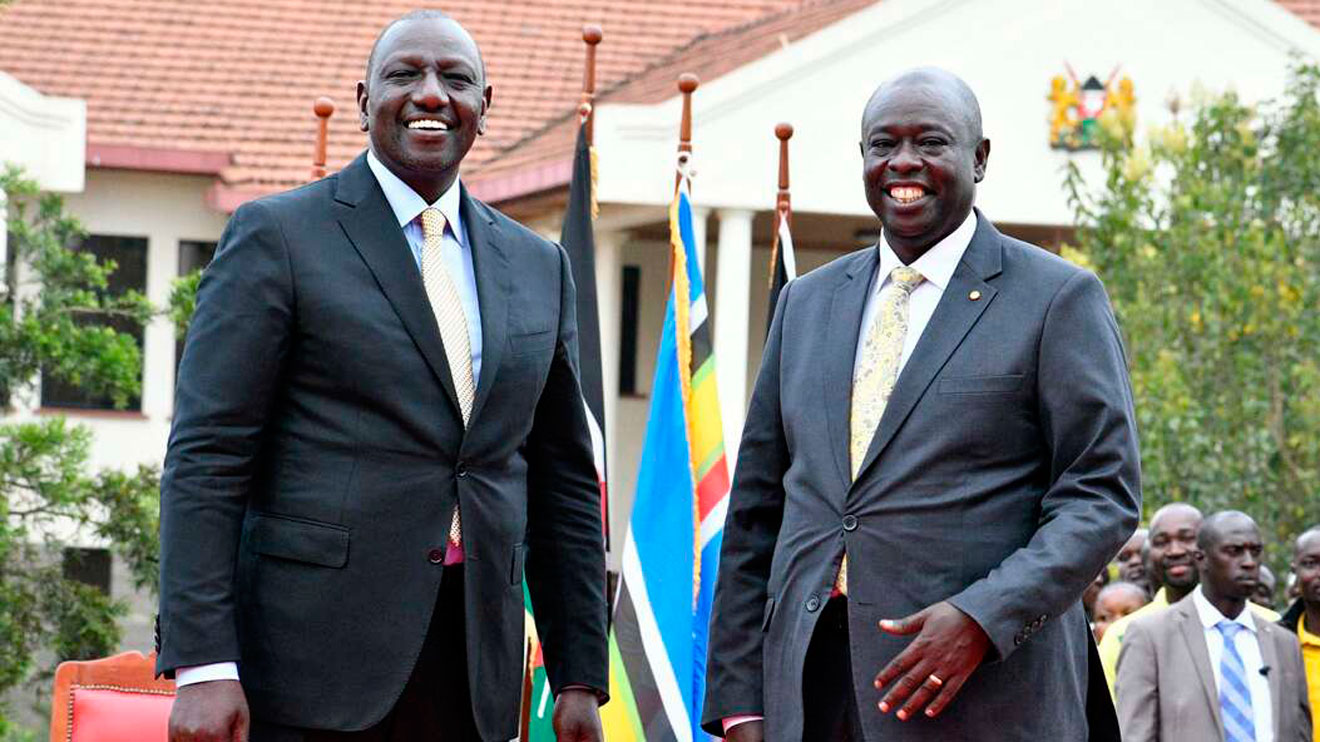
Kenyans in the next three weeks will find out whether the rift between President William Ruto and his deputy, Rigathi Gachagua is real or an attempt to divert national attention from many ills that have been brought about by the Kenya Kwanza government.
Just when one thought President William Ruto would close ranks with his deputy Rigathi Gachagua after being rattled by the Gen Zs protests in June and July, the opposite seems to be the case, despite widespread dissatisfaction with their government. The rift between the two topmost leaders seems to be widening, with the foot soldiers on both sides becoming bolder in speaking more openly about it.
As we went to press, Kenya’s National Assembly and the Senate were set to discuss an impeachment motion to oust Gachagua beginning Tuesday, October 1 based on 10 grounds.
The motion has been supported by the National Assembly Speaker, Moses Wetangula, while the Majority Leader Kimani Ichungwa confirmed that it will be tabled on Tuesday.
Tabling the motion will require 233 MPs to support it to sail through, with reports indicating that as of the close of business Sunday, September 29, 302 members of parliament had appended their signatures.
Gachagua is accused of violation of articles 147, 148,174,186 and 189 which speak to his conduct and responsibility as the principal assistant to the President. He is also accused
of corruptly and unlawfully acquiring assets using taxpayers’ money.
The motion has also included a list of offences against both domestic and international law, citing as grounds for impeachment the National Cohesion and Integration Act, the Economic Crimes Act, the Proceeds of Crime and Anti-Money Laundering Act, the Penal Code, and the Leadership and Integrity Act.
In addition, Gachagua is accused of disobeying the deputy president’s oath of office by viciously criticising Lady Justice Esther Maina, a judge on the Kenyan High Court, and the Director General of the National Intelligence Service. He is also accused of openly opposing the president’s policy positions and Cabinet directives, which amounts to insubordination.
Gachagua himself has been all the rage, coming out on many occasions to express his frustration with the government, he believes, he contributed immensely to putting in power.
One of his most profound pronouncements was a live interview with Citizen Television on September 20. While struggling not to accuse his boss directly, he left no doubt that Ruto was the principal author of his woes.
Gachagua was particularly candid on the issue of a possible impeachment that could knock him off the power pedestal. He also narrated how he had been removed from a social media platform that detailed the president’s itinerary, to ensure he did not keep track of the boss’s whereabouts.
“There is no motion of impeachment against the deputy president that can find itself on the House floor unless the president nods. Nobody else can push it apart from the president,” Gachagua said.
Besides exposing President Ruto as the engineer of his woes, the pronouncement confirmed Kenyans’ fears that Ruto since coming to power on September 2022 had crippled parliament, always whipping MPs to vote for whatever he fancies.
However, one of the Gachagua detractors Didmus Barasa, told the Number Two off, asserting that Parliament respected its independence and had been emboldened by the invasion by the Gen Zs over their stand on the controversial Finance Bill 2024, which the youngsters felt was being forced down the throats of Kenyans by the Ruto.
Barasa maintained that Gachagua would be sent home by the lawmakers before the end of the year, and that would have nothing to do with the president’s nod. Deputy National Assembly Speaker Gladys Shollei echoed the sentiments, asserting that she will take charge of the impeachment process when the matter comes up in the House.
“I will send you home myself. I am putting you on notice. You are going to be impeached, and I can confirm that to you,” she said in a video circulating on social media.
Kenyan presidents falling out with their deputies is not a new phenomenon. However, the Ruto Gachagua imminent parting of ways has happened sooner than many had expected, considering the circumstances that brought them together.
In Kenya’s toxic ethnic-driven politics, Ruto was essentially elected by Gachagua’s majority Kikuyu (Gema) community, most of who did not like him, but considered him a better option to Raila Odinga, a Luo, who they detest more.
It is on record that back in 1969, Kenya’s founding father Jomo Kenyatta administered an oath to the Kikuyus to never allow the Luos to ascend to power. Were it not for the fact that the DP position was entrenched in Kenya’s Constitution 2010, Gachagua would long have been replaced.
A sizeable chunk from his ethnic backyard too also wants him sent home. They now reckon to prefer Internal Security Cabinet Secretary Kithure Kindiki being their tribal kingpin and a link to the highest office in the land.
However, the equally big chunk of the Gachagua ethnic adherents feel betrayed by Ruto, who following the June protests, formed a broad-based government, accommodating supporters of Raila, a hatred for who seems to unite the Kikuyus more than anything else does.
Impeaching Gachagua will require a two-third parliamentary vote, which may prove tricky. However, the marriage between him and Ruto has long but collapsed and the sooner they parted ways, the better.
The duo may choose to cling together and render a disservice to Kenya for the next three years, as Uhuru Kenyatta and Ruto did during their second term between 2017 and 2022.
Some analysts doubt the impeachment route, arguing that it is a trick between Ruto and Gachague, to galavanise Mt Kenya voters behind the DP to be delivered at a later date—after Ruto realised that he has lost the support of Central Kenya. Most supporters of Mr Odinga believe that this was the trick that the former president played to ensure that Ruto appeared as the victim and gave him sympathy votes in 2022.
The question remains, will Ruto go unscathed politically in case of a successful impeachment of his deputy, or failure?
First, Kenyan will question his sense of judgment for succumbing to political expedience in 2022 to pick a running mate he knew was “unsuitable”. Secondly, if Ruto chooses to call off the impeachment—as has been rumoured by other quarters—he will put himself in a political roller-coaster.
He will be seen as weak and could lose many political allies, while at the same time exposing his Central Kenya MPs supporting to “annihilation” by a would-be emboldened Gachagua.
Should the impeachment succeed, Ruto will be forced to forget about 5 million votes from Central Kenya and seek fresh ethnic allies for the 2027 elections. The ball has started rolling.

