

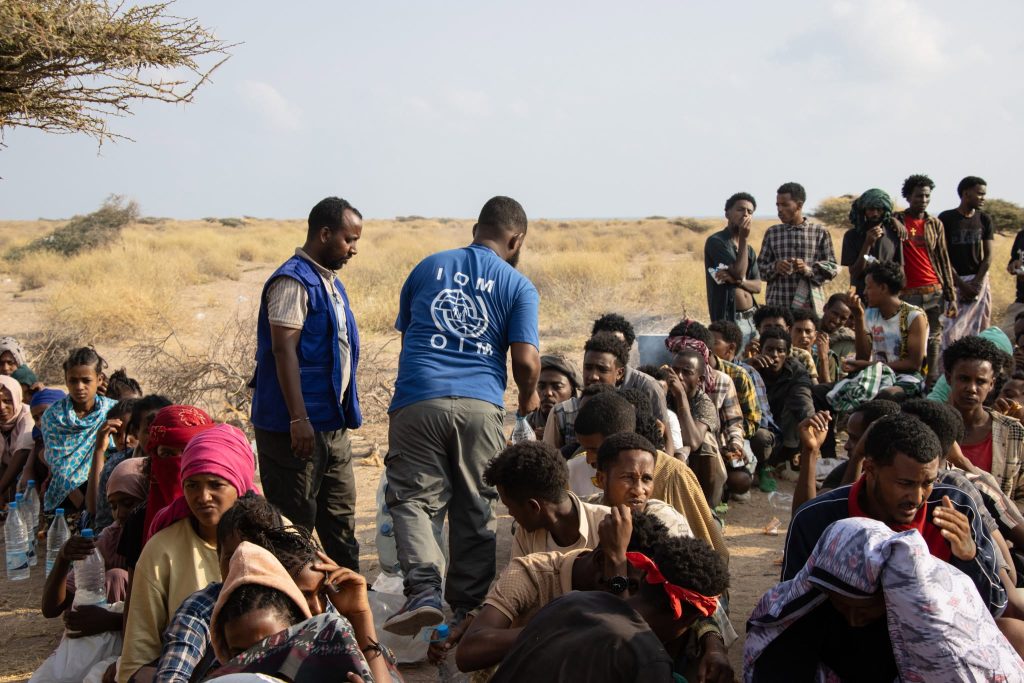
Migrants stranded on the way to Djibouti (Courtesy IOM)
By Fred Oluoch
Eastern Africa marked the World Day Against Trafficking in Persons on July 30, yet the region continues to experience an increase in irregular migration on the Eastern route with the final destination being Saudi Arabia.
Every year, hundreds of thousands of migrants, including women and children, leave the Horn of Africa in search of safety, opportunity, and dignity along the Eastern Route towards Yemen and the Gulf through Djibouti.
According to the latest figures released by the International Organisation for Migration (IOM), the majority of the more than 506,000 movements since 2025, in which about 900 people were reported dead or missing, came from Ethiopia and Somalia, where they gather in Yemen with the hope of finding work in Gulf countries.
Yemen itself has become a major bottleneck where thousands of migrants find themselves stranded in difficult and often dangerous circumstances. More than 238,000 movements were recorded along the route in 2025 – a 34% increase compared to the previous year.
Across deserts and seas, migrants face shipwrecks, dehydration, exploitation, trafficking, detention, gender-based violence and death. IOM Regional Director for the Horn and Southern Africa, Frantz Celestin, says that Young people are leaving home to find work they cannot find in their own countries to support their families.
“This is not just a migration story but a litany of climate change issues; health; gender protection issues; human rights, gender-based violence, and development story. These are not just statistics. They are people whose lives matter,” said Mr Celestin.
Key migration drivers include conflict and insecurity, climate change, environmental degradation, poverty, and health crises. Most migrants come from rural areas, lack documentation, and become victims of smugglers. Actual numbers are likely higher because of underreporting, but the majority (90 percent) of migrants on the Eastern Route are from Ethiopia—mainly Amhara, Tigray, and Oromo.
Close to 1,000 deaths and disappearances have been recorded in the last year, and over 7,000 drownings in the Gulf of Aden off the Djiboutian coast. Yet despite the scale of this migration, the human stories behind the data remain largely untold. An urgent migration humanitarian crisis continues to unfold, largely outside international headlines.
Khalil Omarshah, Programme Officer for Protection, IOM Ethiopia, said that the risks are not just along the route but follow migrants across borders, as each group of migrants faces different protection risks.
Among the risks the migrants are facing migrants include: limited access to humanitarian and protection assistance; hunger and thirst; exploitation and abuse; grave human rights violations; trafficking for forced labour and sexual exploitation; violent extortion, among others.
Groups facing the greatest protection risks include: children, women, persons with disabilities, older persons, and pregnant and lactating women. And victims of trafficking.
The IOM intervenes through its Migrant Response Plan (MRP) targeting stranded migrants, returnees and host communities. Key supports include economic assistance, food, medical care, and shelter. And basic healthcare, though the assistance is hardly sufficient.
