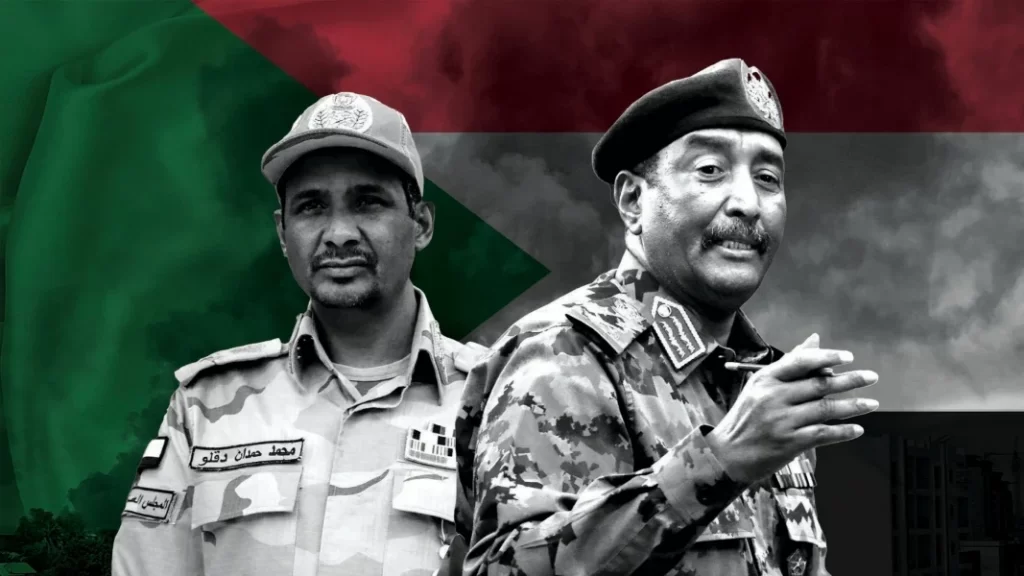
While most people all over the world believe that the conflict in Sudan is about the power struggle between the chairman of the Sovereign Council, Abdel Fattah Abdelrahman al-Burhan and his deputy, Gen Muhammed Dagalo,their several countries that are fueling the war due to their vested interests.Various countries Russia, Saudi Arabia, United Arab Emirates, the United States, Egypt and the UK have vested interests in Sudan. The conflict in Sudan has been triggered by the conflicting interests of various countries that have aligned themselves either with Gen al-Burhan or his deputy,Gen Dagalo—the commander of the Rapid Support Forces (RSF). Officially, the conflict that started on April 15 was due tothe refusal by RSF to be integrated into the national army. The Sudan ArmedForces (SAF) spokesperson, Gen Nabil Abdallah said that RSF had refused to be integrated into the national army, yet the country cannot have two armies with different commands.However, the issue is not just domestic. Top on the list is the rivalry between Russia and the US over plans by Moscow to establish a naval base in the Red Sea—which the US is totally against. Sudan recently agreed that Russia would construct a naval base in the red sea in return for the supply of weapons and military equipment for 25 years with a possible possibility of renewal for 10years. It will the first Russian base inAfrica.This was after Gen Dagalo—who is seen to be closer to Russia—visited Moscow in February in which he sought deeper ties with Russia.Sudan, which is heavily dependent on foreign aid and investment, was largely cut off by the international community following the October 2021 coup. Due to sanctions, Sudan is going through an economic crisis; a shortage of bread and fuel. The debt relief was suspended by the international community after Gen Burhan staged a coup in October 2021 coup.Muhammed Amin, a Political Analyst based in Khartoum says that the conflict was fueled by the conflict of interest in the gold mining areas between Gen Burhan and Gen Dagalo who support different for the monopoly of themines.The RSF is collaborating with the Russian paramilitary firm,the Wagner group to control the gold mine in Sudan and the Vakanga diamond mines in the neighbouring Central African Republic.In Africa, Egypt, which has a long history of influence inSudan has been supporting Gen Burhan, and Cairo has not been enthusiastic aboutthe return to civilian rule.It is not by coincidence that RSF arrested 27 Egyptian military officers and technicians of the Egyptian Air Force in the northern region of Morowe. The RSF had stormed the military air base where the military trainers had been stationed five days prior to the conflict. Gen Dagalo has been protecting the RSF from losing identity once they are merged into the national army. This issue has delayed the signing of the agreement for the return of civilian rule that was supposed to take place on April 6.The RSF was established in 2013 by former president Omalal-Bashir. The group is an offshoot of the Janjaweed militia that was accusedof atrocities in the western region of Darfur. Gen Dagalo also sent a number ofRSF soldiers to fight in Yemen on the side of Saudi Arabia. Yet Gen Dagalo has been accusing the military junta ofclinging to power and refusing to lay the ground for the return of civilian rule. Analysts say that Gen Dagalo must have gotten the impression that hecould get support from some members of the international community if he allied himself with the pro-democracy forces pushing for the return to civilian rule. In March, Gen Dagalo called on the army to hand over power to civilians and vowed to “resist” those who want to cling to power, a statement that surprised many Sudanese who thought he was working closely withGen al-Burhan. Dr Workneh Gebeyehu, the Executive Secretary of theInter-Governmental Authority on Development (Igad) said during a virtual conference of the regional leaders, that despite the conflict, the civilian and military signatories of the Political Framework Agreement of December 5, 2022,including SAF and RSF have made commendable progress in the past few months towards the signing of a final political agreement that paves the way to theformation of a transitional government. Dr Gebeyehu urged civilian parties and stakeholders in the Republic of Sudan to engage in assisting the cessation of fighting and return to the negotiation table inconsultation and coordination with the Trilateral Mechanism.Sajjan Gohel, the Director of the International SecurityFoundation—Asia and Pacific, says that the solution to the Sudan conflict lieswith the four countries; Saudi Arabia, United Arab Emirates, United States andthe UK—who have been trying to bring peace between Gen Burhan Dagalo.But then, SAF put a new twist to the conflict byaccusing some unnamed Sudanese neighbours of supporting Gen Dagalo. Top armyofficial, Shams al-Din Kabbashi, a member of the Transitional Sovereign Councilin Sudan, accused two neighbouring countries of providing military support tothe Rapid Support Forces (RSF).He said that RSF received ammunition and arms from one ofthe neighbouring countries and the other sought to support RSF if theysucceed in the coup. This is a clear indication that the conflict is not homegrown but influenced by outside vested interests.